
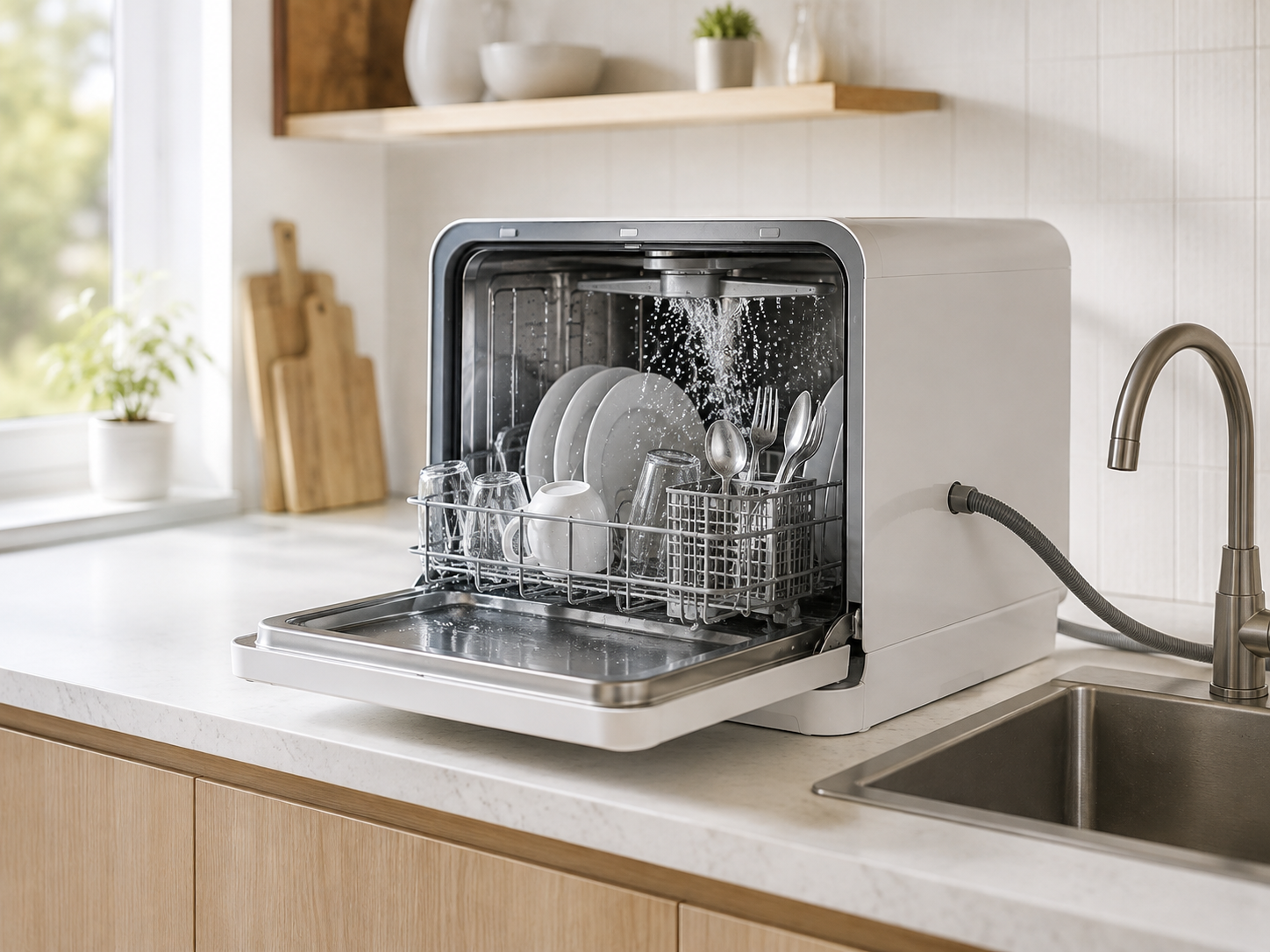
A countertop dishwasher works on the same basic principle as a full-size model, just scaled down to fit on a counter and use less water in the process. Most units connect to a faucet or use a built-in water tank, so setup varies depending on the model and kitchen layout. Once filled, a small pump pushes heated water through spray arms designed to clean dishes in a compact space.
The cycle generally follows a familiar pattern: wash, drain, rinse, and dry. Because these machines are smaller than standard dishwashers, they typically hold fewer dishes per load, which is worth factoring in if you’re cooking or entertaining regularly.
Setup details often make the biggest difference in how well a countertop dishwasher performs. Faucet adapters, drain hose placement, and available counter space can all affect how smoothly the first few cycles go. Readers comparing specific models may find it useful to look at our countertop dishwasher buying guide for a closer look at features and practical trade-offs across different options.
Key Takeaways
How Do Countertop Dishwashers Work?
Countertop dishwashers connect to a kitchen faucet using an inlet hose, or in some cases draw from a manual-fill tank. This water supply allows the unit to operate without a permanent plumbing connection, which is part of what makes these machines suitable for smaller kitchens or rental spaces.
Once water enters the machine, an internal heater warms it, typically in the range of 120 to 140°F, before it mixes with detergent. This combination of heat and detergent is designed to loosen and break down food residue on dishes.
A circulation pump then moves the heated, soapy water through rotating spray arms. These arms jet water onto dishes from multiple angles to dislodge remaining food particles.
The wash cycle isn’t a single pass. The machine typically drains the dirty water, refills with clean water for rinsing, and repeats this process as needed before moving into a drying phase. Drying methods vary by model and may include a heating element, a venting system, or simply leaving the door open at the end of the cycle.
Wastewater exits the unit through a drain pump connected to a hose, which is usually routed into the kitchen sink. Keeping this hose free of kinks and properly looped is an important maintenance step, since improper setup can lead to backflow issues.
Understanding this basic cycle can help when comparing models, since differences in pump strength, heating elements, and drainage design affect wash performance and ease of use. For readers narrowing down specific options, our countertop dishwasher comparisons look at how these features play out across different models and price ranges.
How Countertop Dishwashers Work
A countertop dishwasher operates on the same basic principle as a full-size unit, just scaled down to fit a small tub near your sink. You load dishes, add detergent, select a cycle, and the controls manage the rest of the process.
Hot water enters through the inlet hose, then a circulating pump pushes soapy water through spinning spray arms. These jets are typically strong enough to lift off food residue without requiring a full pre-rinse of every plate, though heavily soiled dishes may still benefit from a quick rinse first.
Many models rely on a built-in water tank instead of a permanent plumbing connection, letting the unit fill manually so it can be used in kitchens, apartments, or RVs without hookup to a faucet.
Between wash and rinse stages, a drain pump removes the dirty water. Sensors coordinate the filling, washing, rinsing, and draining stages, and some models include a heating element to assist with drying.
Cycle times generally range from one to four hours depending on the settings selected. This is worth factoring into your routine, since a full cycle on a countertop unit can take noticeably longer than washing a small load by hand.
If you’re comparing specific models, our countertop dishwasher buying guide breaks down capacity, water usage, and control differences to help match a unit to your kitchen setup.
Where Countertop Dishwashers Get Water
Most countertop dishwashers connect directly to a kitchen faucet for their water supply. This typically involves attaching an inlet hose to a faucet adapter, and in many cases the faucet aerator needs to be removed first for a proper fit.
Running the tap until the water turns hot before starting a cycle is a common recommendation, since warmer incoming water can support the appliance’s cleaning performance. Once the hose is connected, the dishwasher fills according to its internal sensor, drawing in only the amount of water needed for that cycle.
Based on the specifications for most countertop models, a single cycle uses somewhere in the range of 3 to 6 liters. This is a relatively small volume, so there isn’t a meaningful risk of water overflow during normal operation.
Some countertop dishwashers are designed with a built-in water tank instead of a direct hose connection. With this setup, you fill the reservoir manually before running a cycle, which allows the unit to operate away from a sink. This reservoir-based design mirrors the way many humidifiers work, relying on a manually filled tank rather than a fixed water line. The trade-off is that tank capacity is limited, so these models are generally better suited to smaller loads or less frequent use compared to hose-fed alternatives.
If you’re comparing options based on water hookup type, it’s worth checking each model’s listed capacity and connection method before deciding which setup fits your kitchen layout.
How Water Is Heated and Sprayed
Once the tub fills, a countertop dishwasher heats the water to a cleaning-effective range, typically around 120 to 140°F (49 to 60°C). Many models include an internal heating element that boosts water temperature if the connected faucet doesn’t supply hot enough water on its own. This feature can matter for kitchens where the hot water line runs cooler than ideal.
The electronic control shuts off the water inlet valve once the tub reaches the correct fill level. This prevents overfilling and helps the unit manage water use more precisely than a basic timer-based system would.
After heating, the circulating pump pushes water mixed with detergent through the spray arms. As the arms rotate, jets of water are directed at dish surfaces to dislodge food particles, including in harder-to-reach spots. This reliance on heated water for breaking down grime is similar to how steam cleaners use high temperatures to loosen dirt on floors and surfaces.
Spray arm holes can become blocked over time by food debris or mineral buildup, which reduces water pressure and cleaning performance. Regularly checking and clearing these holes is a simple maintenance step that helps the unit continue working as intended. For anyone comparing models, it’s worth checking whether spray arms are removable, since this can make cleaning and troubleshooting considerably easier.
The Wash, Rinse, and Drying Cycle
A dishwasher moves through a straightforward sequence: wash, drain, rinse, and dry. During the wash phase, the circulating pump sends hot, detergent-mixed water over the dishes while the spray arms handle the physical scrubbing.
Once washing finishes, the drain pump clears out the dirty water so the unit can refill for one or more rinse cycles. Longer cycle settings typically add extra rinses or use hotter water, which is why total run time can range from roughly 1 to 2.5 hours depending on the cycle selected.
If a model draws from your home’s tap water supply rather than heating it internally, running the faucet until it’s hot before starting the cycle can help the wash phase reach effective temperatures sooner.
For drying, most dishwashers rely on a heating element, a venting system, or an automatic door-opening feature to help moisture escape. Even with these features, some plastic items or hard-to-reach spots may still come out slightly damp and need a quick towel finish. Many manufacturers also pursue efficiency standards like ENERGY STAR certification to indicate lower water and energy use throughout these cycles.
Understanding this cycle sequence is useful when comparing models, since drying method and total cycle time are two areas where dishwashers can differ noticeably. If you’re evaluating specific options, our dishwasher buying guide breaks down how these features compare across different price ranges.
How Countertop Dishwashers Drain Water
Since countertop dishwashers sit on a counter rather than connecting to household drain plumbing, they rely on an internal pump rather than gravity to remove water. After each wash or rinse stage, a small electric drain pump pushes the used water out of the tub and through a drain hose that empties into the kitchen sink. This cycle repeats throughout the wash program, with old water pumped out before fresh water is brought in for the next rinse. Much like automatic pressure regulation in electric pressure cookers keeps internal conditions safe throughout a cooking cycle, the drain pump in a countertop dishwasher manages water levels automatically without requiring the user to intervene.
Because there’s no gravity drain to fall back on, the drain pump does most of the work in moving water out of the unit. Positioning the drain hose correctly matters for this reason. Most manufacturer instructions call for looping the hose above the sink’s rim rather than letting it hang straight down, which helps prevent siphoning or backflow into the tub.
Kinks or tight bends in the hose can slow drainage or stop it altogether, so it’s worth checking the hose path after setup and periodically afterward. If water pools in the tub or an error code appears on the control panel, food debris trapped in the filter or along the hose is a common cause. Clearing that debris and confirming the faucet adapter is seated securely are typically the first steps listed in troubleshooting guidance for these machines.
Drainage design is one of several practical factors worth weighing when comparing countertop models, alongside tub capacity, cycle options, and hose length. For readers narrowing down specific units, our countertop dishwasher buying guide covers how these features stack up across different models.
Setup, Loading, and Basic Maintenance
Good drainage starts with a sound setup. Most portable and built-in dishwashers need to sit close enough to the sink for both hoses to reach without sharp bends or strain, and installation guides often reference a working distance of around 30 inches, though this can vary by model and kitchen layout. Since countertop space is often limited, it helps to weigh a dishwasher’s footprint against other countertop kitchen appliances you may already own.
For a portable unit, the general steps involve removing the faucet aerator, attaching the adapter, connecting the inlet hose, and plugging into a grounded outlet. Running hot tap water first helps the unit reach an effective washing temperature sooner. Checking hose fittings and connections before starting a cycle can help prevent leaks.
Loading the Dishwasher
Placing plates facing the spray arms, tilting bowls and glasses downward, and keeping flatware in its designated basket are common loading practices that support better cleaning coverage. Detergent amount should follow the manufacturer’s instructions rather than a general estimate, since formulas and recommended doses vary between brands.
Cycle selection affects both water use and wash time, so choosing a cycle suited to the load size and soil level is worth doing rather than defaulting to the same setting each time. If you’re comparing dishwashers with different cycle options, our dishwasher buying guide breaks down what those settings typically mean in practice.
Routine Maintenance
Keeping performance consistent over time usually comes down to a few basic habits: cleaning the filter regularly, clearing debris from the spray nozzles, and running a dishwasher cleaner on the schedule recommended for the model. Skipping these steps is a common reason dishes come out less clean or hoses develop odors.
Maintenance requirements can differ across brands, so checking the specific care instructions for your model is a good practice before assuming a one-size-fits-all routine will work.
Frequently Asked Questions
Are Countertop Dishwashers Effective?
FAQ
Do countertop dishwashers need to be connected to a faucet?
Many models connect to your kitchen faucet with an adapter, while others use a built-in water tank you fill by hand. Either setup lets you skip permanent plumbing work, which is part of what makes these units convenient for apartments or small kitchens.
Can you wash pots and pans in a countertop dishwasher?
Countertop dishwashers are better suited for everyday plates, bowls, cups, and utensils than for large pots and pans. Their smaller interior space limits how much bulky cookware fits inside, so you may still need to hand-wash bigger items.
How do you keep a countertop dishwasher clean and running well?
Basic upkeep usually means wiping down the interior, checking and rinsing the filter, and running an empty cycle occasionally if the unit sits idle. Since these dishwashers are compact, residue and mineral buildup can show up sooner than in full-size models, so a bit of regular attention goes a long way.
What Are the Disadvantages of a Portable Dishwasher?
FAQ
Are portable dishwashers a good fit for renters or people who move often?
Yes, that’s one of their main advantages. Since they connect to your existing faucet rather than requiring permanent plumbing, you can take a portable dishwasher with you when you move, which makes it appealing if you don’t own your home or plan to relocate.
Can a portable dishwasher be converted into a built-in model later?
Some models are designed to be convertible, but not all of them are. If this matters to you, it’s worth checking with the specific manufacturer or retailer before buying, since conversion options vary by brand and model.
How much storage space does a portable dishwasher need when it’s not running?
You’ll need enough floor space to store it between uses, typically wherever it can be rolled out of the way in your kitchen. Because it isn’t built into your cabinetry, planning for that storage spot ahead of time can help you avoid a cramped kitchen layout.
Where Does the Water Go in a Countertop Dishwasher?
FAQ
Do I need to manually drain the water after each cycle?
No, this happens automatically. The dishwasher’s pump pushes used water out through the drain hose once the wash and rinse cycles finish, so there’s no need to scoop or dump anything yourself.
Can I route the drain hose somewhere other than the sink?
In most cases, the drain hose is designed to hook onto the edge of your sink, since that’s the standard setup for countertop models. If your kitchen layout doesn’t allow this, check your specific model’s instructions before attempting an alternative, since not all units are built to drain into a bucket or a separate drain line.
What if my sink doesn’t have enough room for both the inlet and drain hoses?
You may need to get creative with hose placement or consider a sink clip or hook designed for countertop dishwashers. Some sinks have deeper basins or wider edges that make this easier, so it’s worth checking hose length and sink dimensions together before you buy.
Do Countertop Dishwashers Need to Be Plumbed In?
FAQ
Can you run a countertop dishwasher without connecting it to a faucet at all?
Yes, if you choose a tank-fill model. These units let you pour water directly into a built-in tank instead of hooking up to your faucet, which can be handy if your sink setup makes a direct connection tricky. You’ll still need to drain the wastewater somewhere, usually through a hose that empties into the sink or a container.
What if my faucet doesn’t match the adapter that comes with the dishwasher?
Most countertop dishwashers include a few adapter sizes to fit common faucet types, but not every faucet style is guaranteed to work. If none of the included adapters fit, you may need to look into a universal faucet adapter sold separately, or check with the manufacturer before buying if you’re unsure about compatibility with your specific faucet.
Do I need to disconnect the hoses after every wash?
It depends on your kitchen setup and personal preference. Some people leave the hoses connected between uses if the dishwasher sits permanently on the counter near the sink, while others prefer to disconnect and store everything away when not in use. Either approach works, as long as the hoses aren’t blocking normal sink use in a way that’s inconvenient for your household.