
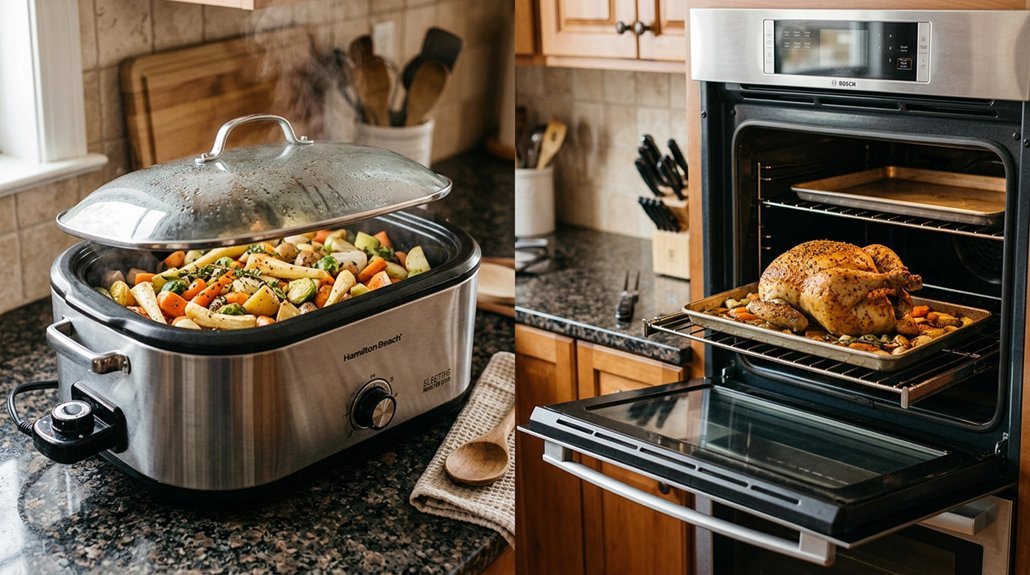
You’ve got two appliances that both cook food with heat, so what’s the big deal? Quite a lot, actually. An electric roaster and a built-in oven work through fundamentally different designs, and that gap affects everything from energy use to browning quality to whether your Thanksgiving turkey turns out crispy or steamed. Each section ahead breaks down exactly where these two diverge.
Key Takeaways
- Ovens are permanent, built-in appliances for baking, broiling, and roasting, while electric roasters are portable countertop units designed primarily for dedicated roasting.
- Roasters trap and concentrate heat in a compact lidded vessel, whereas ovens circulate heat through a larger insulated cavity, often using convection fans.
- Electric roasters cook turkey approximately 30% faster and retain more moisture, while ovens produce crispier, better-browned skin.
- Roasters consume only 1,400–1,750 watts compared to an oven’s 2,000–5,000 watts, making them a more energy-efficient option.
- A roaster’s self-basting lid recirculates moisture automatically, while ovens require foil or manual basting to achieve similar results.
How Electric Roasters and Ovens Differ in Design and Purpose
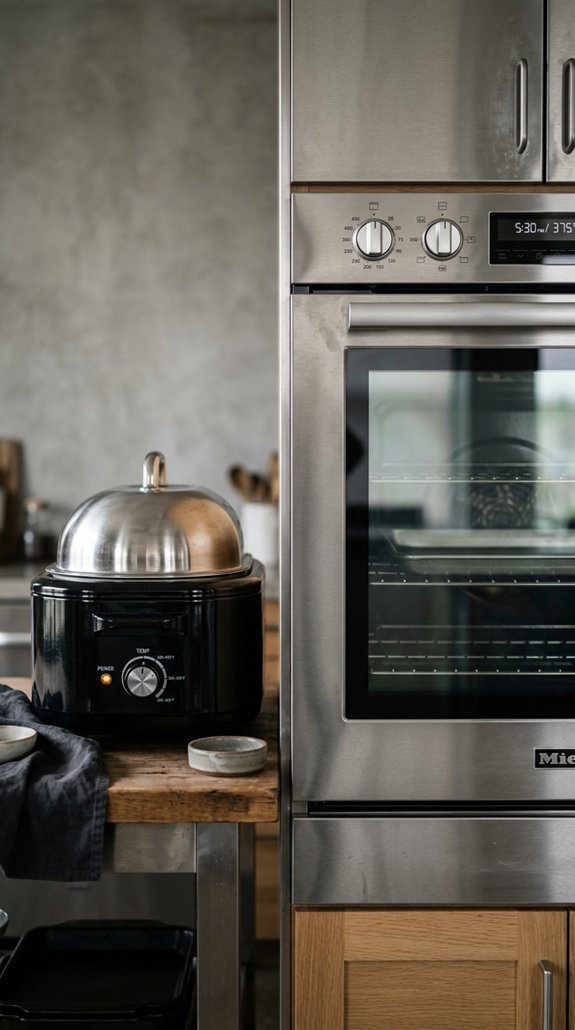
When you’re deciding between an electric roaster and a conventional oven, the first thing to understand is that these two appliances aren’t really competing for the same job.
Ovens are built-in, permanent kitchen workhorses designed for baking, broiling, and roasting across countless recipes. Electric roasters, by contrast, offer countertop portability and a compact form focused on dedicated roasting.
You can move a roaster, store it away, and pull it out specifically when you need it. And that narrower purpose isn’t a limitation. It’s actually the whole point. Different tools, different strengths!
Both appliances rely on heat and mass transfer to bring food to the proper cooking temperature. Electric roasters are particularly well-suited for cooking large cuts of meat, much like a pressure cooker or air fryer serves a specific purpose better than a general appliance might.
Why Roasters and Ovens Are Built Nothing Alike
Once you look past the surface-level idea that both appliances use electricity to apply heat to food, you’ll find that electric roasters and conventional ovens are built almost nothing alike. Material choices, manufacturing cost, and structural priorities drive every design decision differently. Conventional oven elements are commonly manufactured from Kanthal A1 alloys, which withstand temperatures up to 1400°C while the working chamber stays safely within food-use limits. Unlike refrigerant-based cooling units that rely on compressor-driven systems to manage heat exchange, electric roasters trap and reflect heat within a compact lidded vessel rather than circulating it through an engineered cavity.
| Feature | Electric Roaster | Conventional Oven |
|---|---|---|
| Enclosure | Compact lidded vessel | Insulated cavity cabinet |
| Heat source | Base-wrapped heater | Multiple wall-mounted elements |
| Airflow | Trapped, reflected heat | Engineered circulation system |
| Insulation | Lightweight, compact | Layered, heavy-duty |
| Controls | Lift-off lid, simple dial | Thermostat, sensors, rack system |
What Can a Roaster Actually Do That Your Oven Can’t?
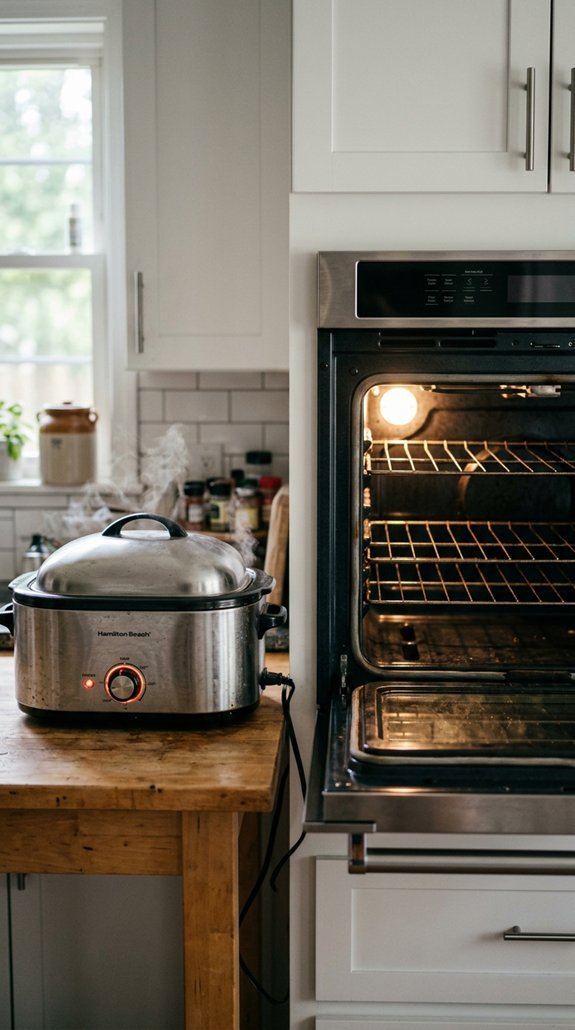
A roaster oven brings a surprising range of cooking functions to the table that your conventional oven simply can’t pull off, at least not without a fight.
Steam cooking vegetables like broccoli or carrots in large batches? Easy. Keeping a buffet holding station running at a safe 140°F or higher without scorching your food? Done. You can also slow cook soups at 200°F to 250°F, warm rolls before serving, or even heat mulled cider.
And that self-basting lid recirculates moisture automatically. Your oven won’t do that without foil, fuss, and probably a minor inconvenience!
For those who want even more versatile countertop cooking options, electric griddles with adjustable temperature controls can handle everything from pancakes and bacon to grilled sandwiches alongside your roaster setup.
Dedicated coffee roasters, like those from Giesen, use advanced PID logic to manage heat with a level of precision that no standard oven can replicate.
Electric Roaster vs Oven: Capacity and Size
All those extra cooking functions are great, but they only matter if the roaster actually fits your food, and your kitchen. Electric roasters are sized by pan volume, ranging from 18 to 28 quarts. A 22-quart model handles up to a 28 lb turkey! But that same roaster stretches roughly 23 inches long and 16 inches wide. That’s a serious countertop footprint.
And larger models push 14 pounds, so you’re not casually tucking one into a cabinet. Your oven, by contrast, uses interior dimensions and rack configurations, giving you more flexible space without claiming precious counter real estate. Slow cookers offer a more compact alternative, with capacities from 1.5 to 8 quarts that take up far less counter space than a full-sized roaster. Professional coffee roasters like the Diedrich DR3-E take up even more room, with a footprint reaching 56.625 x 22.25 inches.
Electric Roaster vs Oven: Which Uses Less Energy?
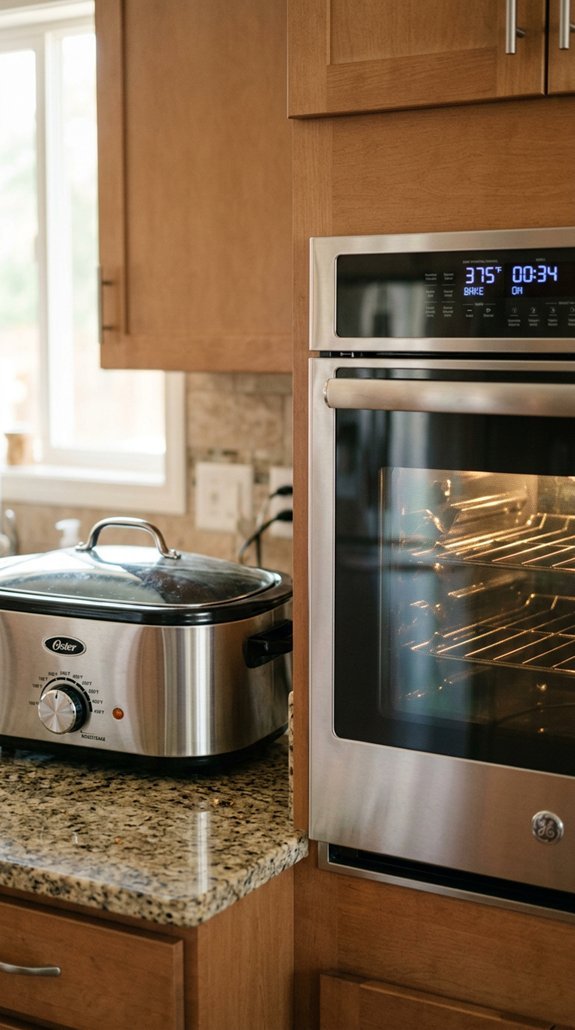
When it comes to energy use, electric roasters have a real advantage over conventional ovens. And the energy comparison is pretty clear. Here’s why roasters win on cooking efficiency:
- Lower wattage: Roasters run at 1,400–1,750 watts versus an oven’s 2,000–5,000 watts.
- Faster preheating: Smaller cavity means quicker warm-up, so you’re using less electricity overall.
- Real savings: Some sources report up to 36% less energy than a conventional oven.
But remember, total kWh depends on both wattage and cook time. For small-to-medium meals, a roaster’s your most efficient option! Conventional ovens typically consume 2 to 3 kilowatt-hours per hour of use, making the roaster’s lower draw even more impactful over longer cooking sessions. For those looking to save even more counter space and energy on smaller tasks, toaster oven air fryers like the Ninja SP101 can preheat in as little as 60 seconds and use significantly less power than a full-sized conventional oven.
How Each Appliance Heats Food: and Why It Matters
Understanding how your appliance actually heats food isn’t just food-science trivia, it’s the key to getting better results from whichever machine you’re using.
Both appliances use radiation, convection, and conduction, but their airflow dynamics differ markedly. A roaster’s compact cavity keeps heat transfer concentrated and consistent around your food. An oven’s larger chamber spreads heat more unevenly unless a convection fan forces air movement. That fan reduces the cool boundary layer around food, speeding surface heating and browning.
Placement matters too! Foods closer to heating elements receive stronger radiant heat. Know your appliance’s heating behavior, and you’ll cook smarter every time.
Electric Roaster vs Oven: Which One Cooks a Better Turkey?
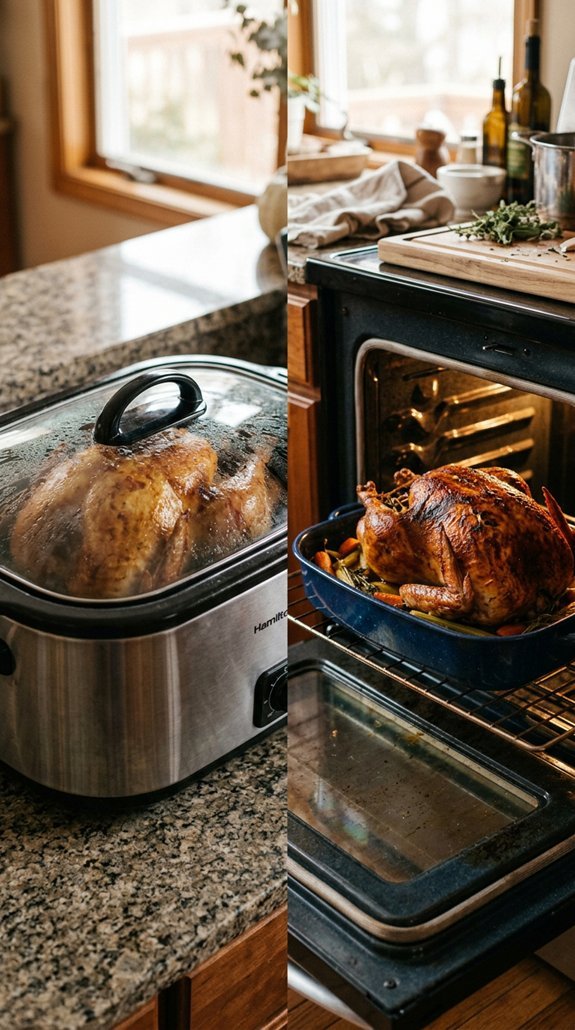
Few kitchen debates get more heated (pun intended) around the holidays than the roaster vs. oven turkey showdown. Each method has real strengths, so your best pick depends on what you’re after:
Few holiday kitchen debates spark more passion than the great roaster versus oven turkey showdown.
- Speed and moisture: A roaster cooks roughly 30% faster and excels at flavor retention.
- Skin texture: A conventional oven wins here, delivering crispier, better-browned skin.
- Space: A roaster frees up your main oven for sides.
And honestly? If juicy meat matters most, go roaster. But if that golden, crackling skin is your priority, stick with the oven!
Roaster or Oven: Which One Should You Actually Use?
The answer really boils down to what you’re cooking and how much flexibility you need.
If your meal planning centers on large roasts, poultry, or big-batch cooking, a roaster is a smart, energy-efficient pick. It cooks faster and uses about 36% less energy than a conventional oven.
But if you need countertop flexibility plus baking, broiling, and multi-stage cooking, your oven wins every time. And if you entertain often? A roaster frees up your main oven entirely.
Frequently Asked Questions
Can You Use an Electric Roaster as a Slow Cooker?
Yes, you can use an electric roaster as a slow cooker! Set your temperature control to around 200°F, keep the insert pans covered tightly, and you’ll achieve that signature slow-cooked tenderness.
Are Electric Roasters Safe to Use Indoors and on All Countertops?
You can safely use electric roasters indoors, but not on all countertops. Follow safety guidelines by choosing heat-resistant, stable surfaces. Surface compatibility matters—avoid flammable materials and guarantee proper ventilation clearance around the unit.
How Do You Clean an Electric Roaster After Cooking?
Like peeling back layers of an onion, cleaning starts with unplugging, cooling, then washing removable parts in soapy water. For nonstick maintenance and stain removal, soak stubborn residue, wipe the base carefully, and dry everything completely before storing.
Can an Electric Roaster Replace a Second Oven During Holidays?
Yes, an electric roaster can act as a space saving solution by handling your turkey while your oven manages sides, improving holiday timing and keeping your entire meal on schedule.
What Cookware and Accessories Are Compatible With Electric Roasters?
You can use metal, cast iron, or hard-anodized pans with your electric roaster. Nonstick pans work well for easy cleanup, and silicone lids help retain moisture during long roasting sessions.
Conclusion
Your kitchen’s a toolbox, and every tool has its job. If you’re feeding a crowd or freeing up oven space, the electric roaster’s your workhorse. But if you need precise browning, multi-rack baking, or true versatility, the built-in oven wins every time. You don’t have to choose one forever, just choose the right one for the moment. Know your cook, know your appliance!