
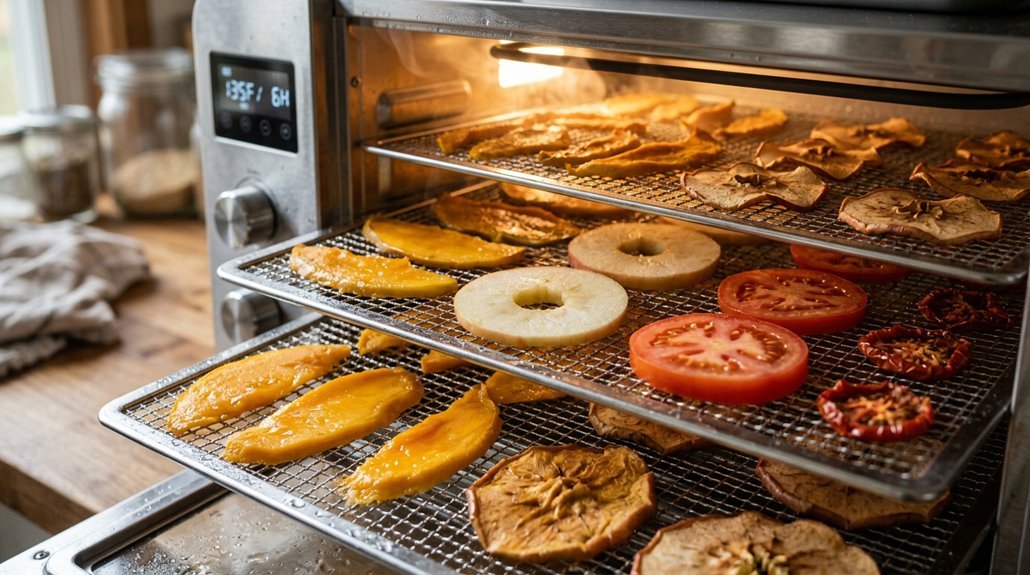
Most food dehydrators run anywhere from 1 to 36 hours depending on what you’re drying, and that wide range isn’t random. Moisture content, slice thickness, and temperature all interact in ways that can either speed things up or stall them completely. Knowing these variables means you’ll stop guessing and start dehydrating with confidence, and the specifics ahead will show you exactly what to expect for each food type.
Key Takeaways
- Most foods take 4–12 hours in a dehydrator, though dense, high-moisture fruits and vegetables can exceed 12 hours.
- Herbs dry fastest, typically finishing in 1–4 hours at 95–115°F to preserve their volatile oils.
- Jerky drying time depends on thickness: 1/8-inch takes 2–3 hours, while thicker cuts require up to 10 hours.
- Slice thickness, moisture content, ambient humidity, and tray crowding all significantly impact total drying time.
- Always test doneness after cooling; fruits should feel leathery, vegetables should snap, and herbs should crumble easily.
How Long Does a Food Dehydrator Actually Take?
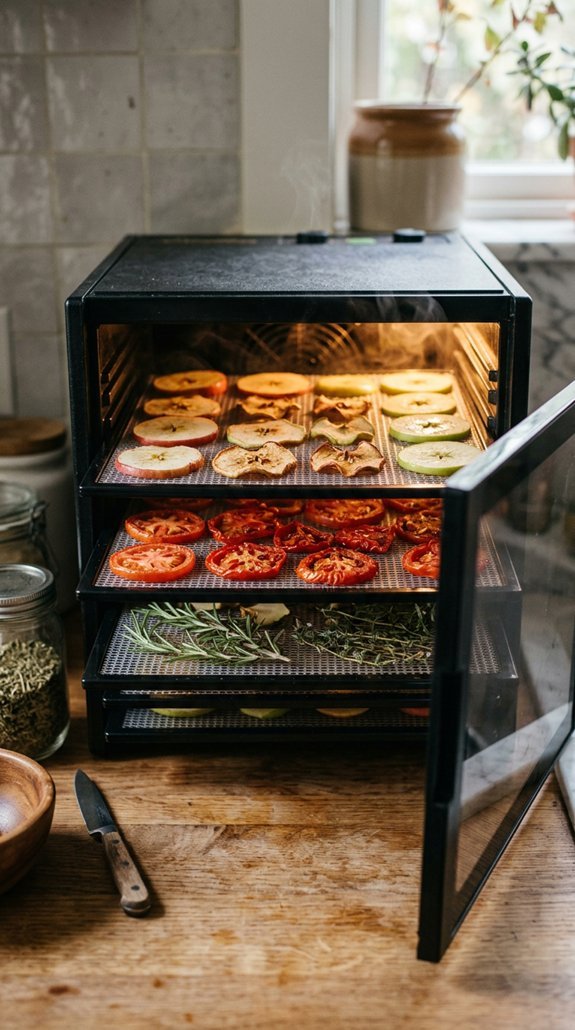
Food dehydrators typically take anywhere from 4 to 12 hours for most common foods, though that range tells only part of the story.
Most foods take 4 to 12 hours in a dehydrator — but that range barely scratches the surface.
Thin, low-moisture items like herbs can finish in just 1 to 2 hours. Dense fruits and vegetables, especially those with high water content, can run well beyond 12 hours.
Seasonal availability also matters since fresher peak-season produce often dries more efficiently than older, stored items.
And don’t overlook energy consumption: longer drying times mean more electricity. Knowing your food’s specific requirements helps you plan smarter, not just set it and forget it! The dehydrator’s heating element and fan work together to circulate warm air evenly, making it one of the most reliable methods for consistent results.
Thickness, Moisture, and Temperature: What Changes Drying Time
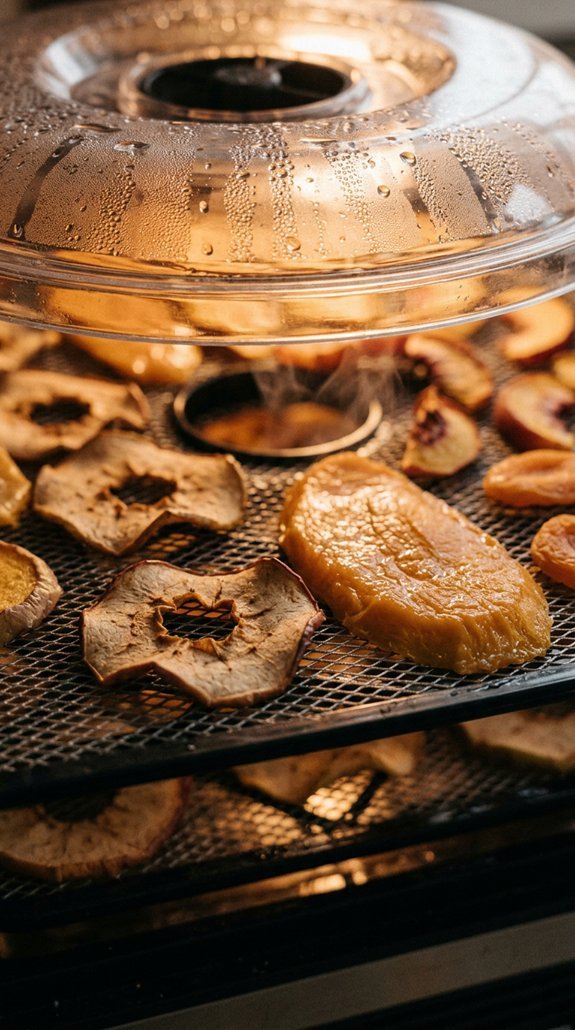
Three variables do most of the heavy lifting when it comes to dehydrator drying times: slice thickness, moisture content, and temperature.
Thinner slices, around 1/8 inch, release moisture faster than 1/4-inch cuts.
Juicy produce simply carries more water, so it needs more hours regardless of thickness.
Temperature matters too: fruits dry well around 135°F to 150°F, vegetables around 125°F, and herbs closer to 95°F to 115°F.
And don’t overlook ambient humidity or airflow patterns inside your unit, since both affect how efficiently moisture escapes. Just as chemical-free cleaning relies on heat and steam pressure rather than added agents, dehydrating relies purely on controlled heat and airflow to remove moisture safely from food.
Check doneness by texture, not just the clock! Dried foods should feel crispy or leathery, and a soft texture means they need more time in the dehydrator.
Food Dehydrator Times for Common Fruits
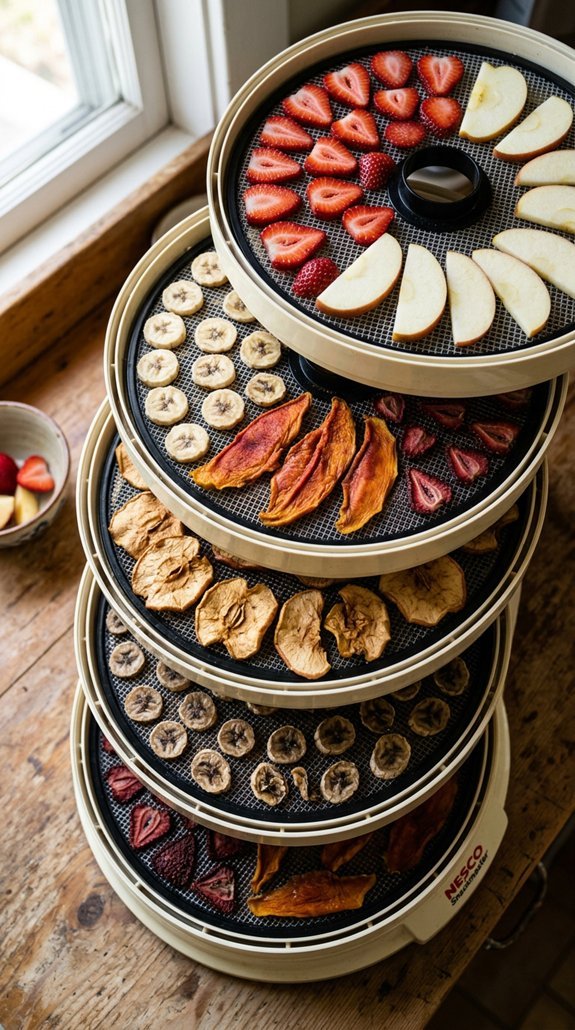
Knowing your variables is only half the battle, and now it’s time to put those numbers to work with real fruit. Fruit sugars and moisture content directly shape your drying schedule, so expect wide ranges across different fruits.
Here’s a quick breakdown:
- Apples and bananas: 6–12 hours at 135°F
- Mangoes: 6–14 hours, finishing leathery and pliable
- Peaches: 8–16 hours, sometimes longer
- Grapes and pears: 12–36 hours, because higher fruit sugars slow everything down
And yes, patience pays off! To prevent browning and help preserve vitamin C, dip light-colored fruit slices in a mixture of one cup water and one tablespoon lemon juice for five minutes before placing them in the dehydrator — a simple pre-treatment step that also improves the finished product. Once your fruit is ready, spreading slices in a single layer on a ceramic nonstick surface ensures even airflow and consistent drying results.
Food Dehydrator Times for Vegetables (and Why Herbs Are Much Faster)
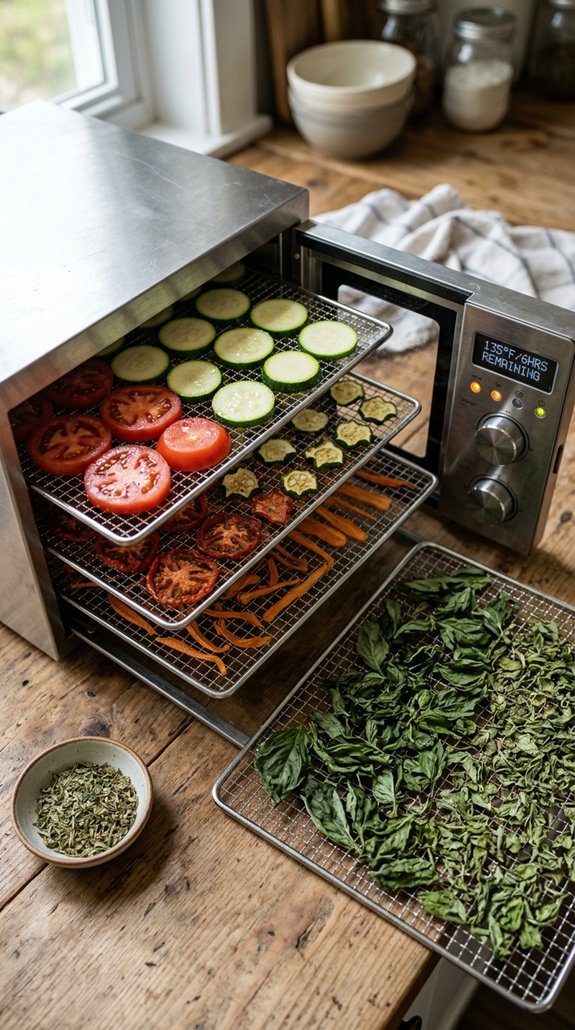
Vegetables are generally more forgiving than fruit when it comes to dehydrating, but they still ask for your patience. Most land between 4 and 14 hours at 125–135°F. Dense picks like carrots and beets need 10–12 hours, while broccoli can push 15. Watch your dehydrator load carefully! Crowded trays disrupt airflow patterns and stretch drying time markedly. Uniform slicing keeps everything finishing together. Frozen vegetables are usually pre-blanched, which means they dry faster than their fresh counterparts.
Herbs, though? Totally different story. Their thin leaves and low moisture mean 1–4 hours at a gentler 95–115°F. That lower temperature preserves their delicate volatile oils, which is exactly what you want. For the drying environment itself, keeping ambient humidity low matters too, and units with smart humidity control can maintain optimal conditions in the room where you’re working.
How Long Does Jerky Take in a Food Dehydrator?
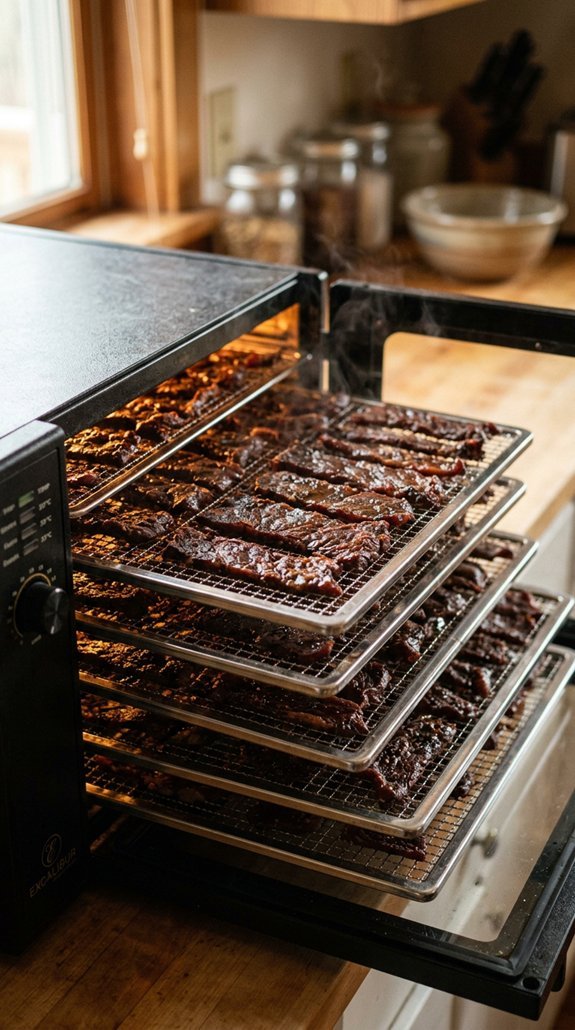
Jerky almost always takes longer than people expect, and thickness is the main reason why. Here’s a quick breakdown:
- 1/8-inch slices dry in about 2 to 3 hours at 160°F.
- 1/4-inch slices typically need 4 to 6 hours.
- 3/8-inch slices often run 6 to 8 hours.
- Thicker or crowded trays can push past 10 hours.
Airflow importance can’t be overstated since poor circulation slows everything down. And marinade effects matter too because wetter marinades add moisture your dehydrator must remove. Patting strips dry with paper towels before dehydrating can reduce drying time by 30 to 60 minutes.
Jerky’s done when it bends, cracks, but doesn’t snap! For even more consistent results, using a food processor with a reversible slicing disc beforehand helps you cut uniform strips that dry at the same rate.
Texture and Temperature Tests That Tell You Food Is Ready
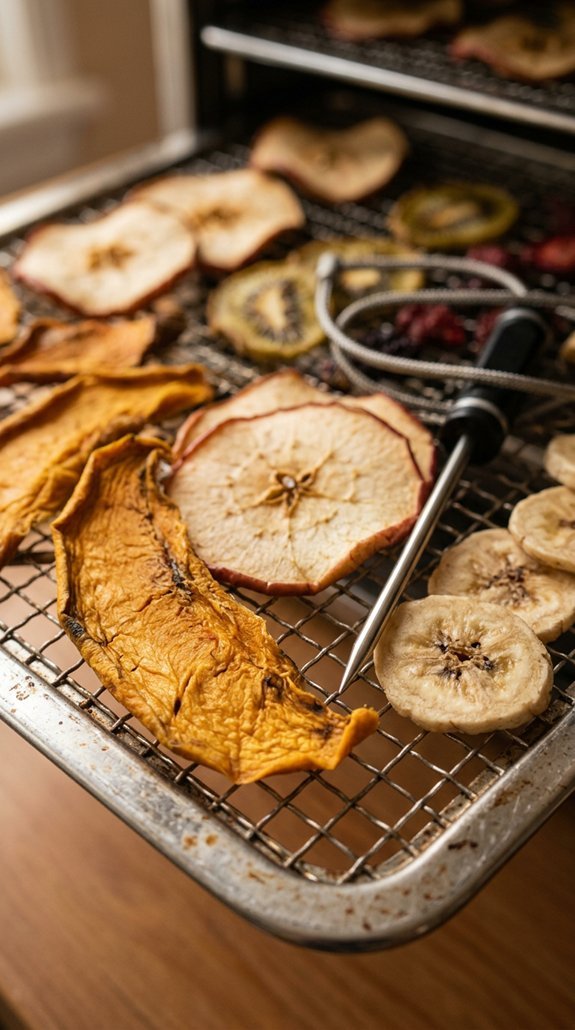
Once you’ve nailed jerky timing, the same question pops up for everything else you dry: how do you actually know when it’s done? Cooling tests matter here. Warm food feels softer than it actually is, so always cool a sample completely first. Then run seal checks by placing a piece in a closed container briefly. Condensation? Not done yet. Just as air purifiers rely on multi-stage filtration systems to capture particles at different sizes, effective food dehydration works in stages too, requiring you to check texture, moisture, and internal dryness rather than relying on time alone. Use this quick reference:
| Food Type | Target Texture | Quick Test |
|---|---|---|
| Fruit | Leathery, pliable | No liquid when squeezed |
| Vegetables | Crisp, brittle | Snaps cleanly |
| Herbs | Crumbly, dry | Crumbles between fingers |
| Leafy greens | Flaky | Breaks into small pieces |
| Thick pieces | Dry throughout | No moist center when torn |
Frequently Asked Questions
Can I Dehydrate Multiple Types of Food at the Same Time?
Yes, you can dehydrate multiple foods simultaneously, but you’ll want to match similar drying times and temperatures. Watch for flavor transfer between strong and delicate foods, as it can ruin your final results.
How Do I Store Dehydrated Food After It Comes Out of the Dehydrator?
Like locking treasure in a vault, you’ll seal your dehydrated food’s freshness by cooling it completely, then storing it in airtight containers or vacuum sealing bags to block moisture and oxygen.
Does a More Expensive Dehydrator Dry Food Faster Than a Cheaper One?
Not necessarily. You’ll find that wattage, airflow, and heat distribution matter more than price. Better build quality in premium models can improve speed, but a mid-priced dehydrator with strong airflow often performs just as fast.
Can I Leave a Food Dehydrator Running Overnight While I Sleep?
Like a refrigerator humming quietly, you can safely leave your dehydrator running overnight. It’s generally safe, but make sure night safety by checking for damage and keeping appliance noise from disturbing your sleep setup.
How Much Electricity Does a Food Dehydrator Use During a Full Run?
Your dehydrator’s energy consumption typically runs 4 to 8 kWh per full session. At 13 cents per kWh, you’re looking at an operating cost of roughly 50 cents to $1 for most runs.
Conclusion
Dehydrating food takes patience, but it’s genuinely worth it. And if you’re worried the process sounds complicated, it really isn’t once you know the basics: slice uniformly, don’t crowd your trays, and match your temperature to your food type. Check for dryness using the texture tests covered above, and you’ll nail it every time. Your dehydrator does the heavy lifting. You just need to plan ahead!