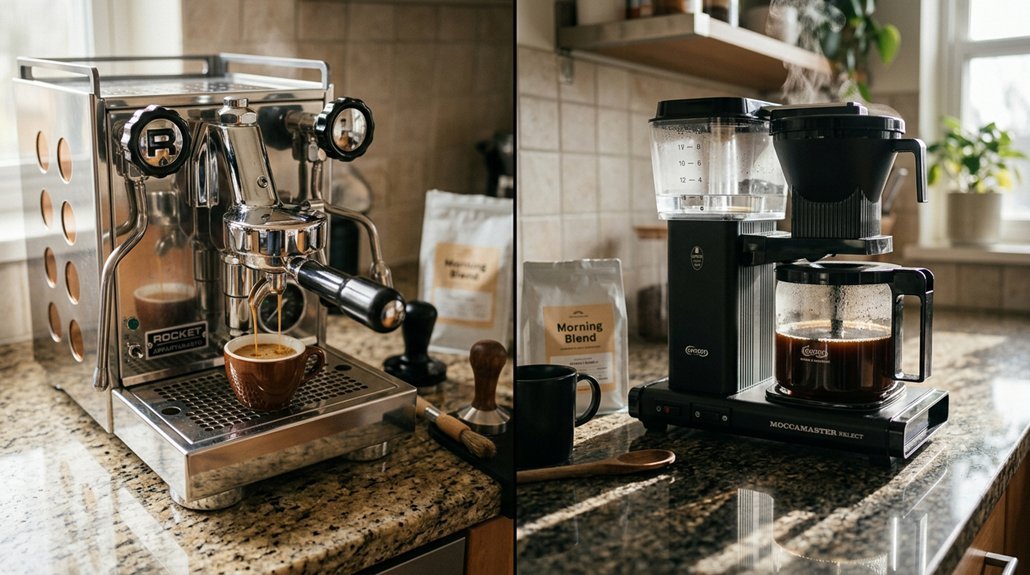
You reach for your coffee without much thought, but the machine behind it shapes more than just flavor. An espresso machine and a drip coffee maker aren’t interchangeable tools—they demand different habits, spaces, and patience levels. Before you decide which one earns a permanent spot on your counter, it’s worth understanding what each one actually asks of you every single morning.
Key Takeaways
- Espresso delivers a quick, concentrated shot in 20–30 seconds, ideal for single-serving, on-the-go routines.
- Drip coffee brews a 4–12 cup carafe in 5–10 minutes, better suited for serving multiple people.
- Espresso demands precise grind size and technique; drip coffee tolerates more variation and simpler workflow.
- Drip makers are quieter and more compact, while espresso setups need extra space and generate more noise.
- Espresso machines cost more upfront and require frequent upkeep; drip makers are cheaper with easier maintenance.
Brewing Basics: Espresso Machine vs Coffee Maker
Force meets finesse when you brew espresso: near-boiling water blasts through finely ground, tightly tamped coffee at roughly 9 bars of pressure, pulling a concentrated shot in just 20–30 seconds and leaving behind that signature crema and syrupy body. Your espresso machine demands precision—grind size matters immensely, and even minor inconsistencies throw off extraction.
A drip coffee maker takes a gentler approach. Gravity, not pressure, does the work: heated water flows through coarser grounds and a filter over several minutes, yielding a milder brew without crema. You’ll get 4 to 12 cups per batch, perfect for serving a crowd. Some models even incorporate a Vortex brewing system to ensure the grounds are evenly saturated for maximum flavor extraction.
Where espresso rewards precision and speed, drip coffee maker brewing favors patience and volume—two distinct philosophies shaping every cup you pour.
Taste and Strength: Espresso vs Drip Coffee
Because pressure and time work so differently in each method, the resulting cups couldn’t taste more distinct.
Espresso relies on roughly 9 bars of pressure forced through finely-ground coffee in just 20 to 30 seconds, creating a syrupy shot with crema and intense flavor packed into every ounce. Drip coffee takes the opposite approach, using coarser grind size and several minutes of contact time to produce a milder, cleaner cup that lets subtle acidity and aroma shine through.
Your grind size matters enormously here: espresso demands precision, since even small inconsistencies cause sour or bitter results, while drip coffee forgives more variation. Roast level plays a role too—darker roasts suit espresso’s boldness, while lighter roasts highlight drip’s brighter notes. Many espresso machines rely on 15–20 bar pumps to achieve the rich crema and consistent extraction that give espresso its signature intensity.
Speed and Serving Size for Your Morning Routine
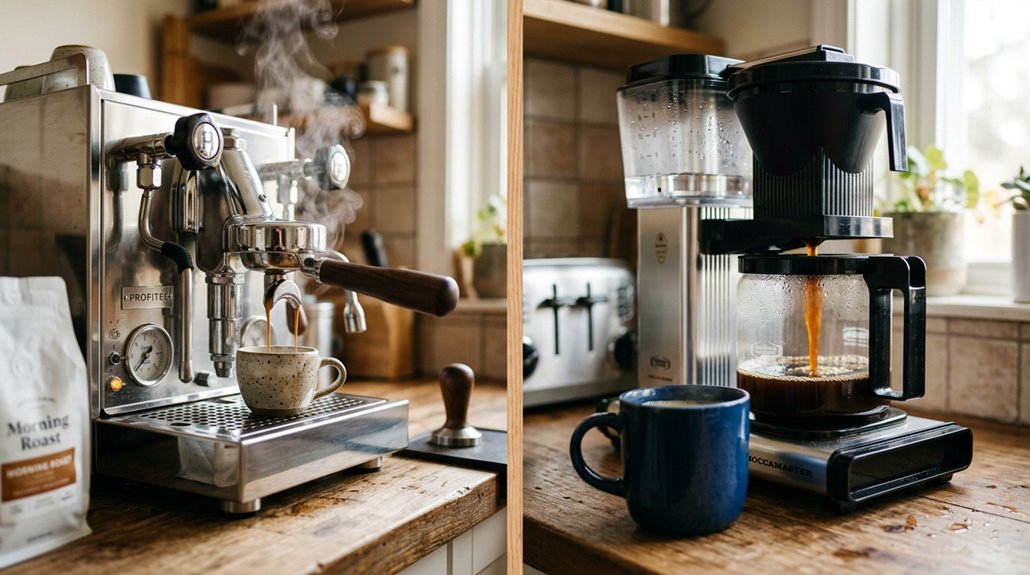
Speed often comes down to how many cups you actually need each morning. An espresso machine pulls a single or double shot in 20–30 seconds, making it fast when you’re brewing for yourself.
But if your household needs multiple servings, drip coffee makers win overall: they brew a full 4–12 cup carafe in 5–10 minutes, covering everyone at once. Serving size shapes your choice as much as speed does.
Super-automatic espresso machines can streamline grinding and frothing, though they’re louder and still produce one drink at a time. Don’t overlook cleanup time, either—drip makers just need a scoop and a button press, while espresso demands tamping, grinding, and more frequent cleaning. Much like dual-zone cooking in multi-basket air fryers lets you prepare two dishes simultaneously, a drip coffee maker’s single carafe brews for everyone at once instead of one serving at a time.
Counter Space, Noise, and Everyday Convenience
Weighing counter space and noise matters just as much as brew time. Drip coffee makers run quieter, at about 45-55 dB, and their compact build fits easily on a small countertop without disturbing anyone nearby. Espresso machines are louder, ranging from 60-70 dB, and they demand more room since you’ll need space for the machine itself plus a grinder alongside it.
Your countertop clutter grows with espresso setups, too. You’ll need to make room for a burr grinder, tamping station, milk pitcher, and knockbox, then clear everything regularly to keep your workflow smooth. Drip coffee makers skip that hassle entirely—just add water, scoop grounds, and you’re set. If you’re looking for a small-footprint alternative that still offers versatility, some compact appliances now include fuzzy logic technology to automate multiple functions without taking up extra counter space. If you value a tidy counter and minimal noise, drip makers offer the simpler everyday choice.
Cleaning and Upkeep: Coffee Maker vs Espresso Machine
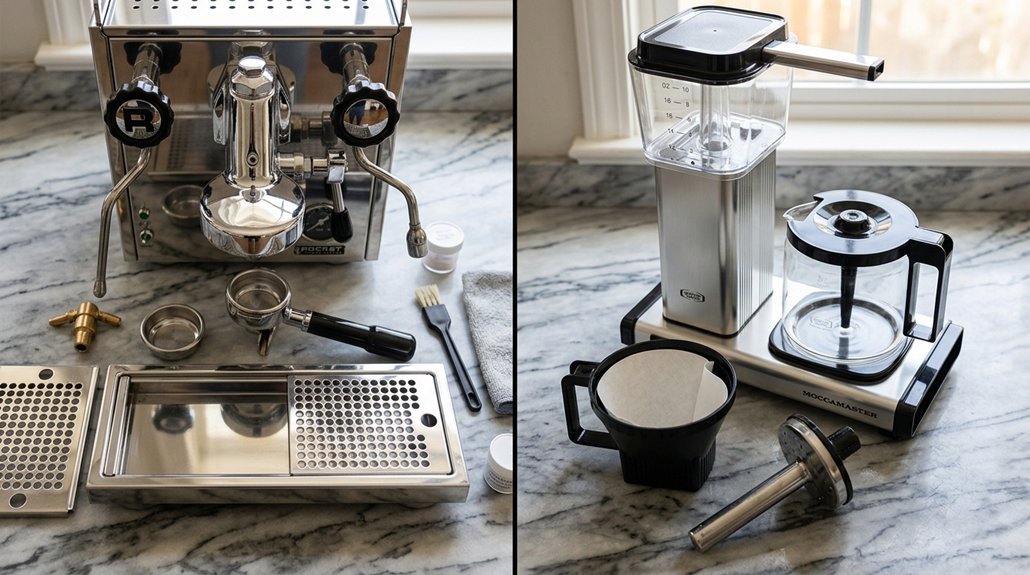
Maintenance demands shift dramatically once you factor in daily upkeep.
A coffee maker asks little: rinse the carafe, swap the filter, and descale every 3–6 months.
An espresso machine asks for commitment. You’re purging the steam wand daily, backflushing weekly if your machine has a group head, and checking gaskets every few months.
Your water matters too. Hard water accelerates scale buildup, forcing you to descale every 1–3 months instead of stretching to six with filtered water.
Here’s what neglect costs you:
- Bitter, inconsistent shots
- Clogged steam wands
- Shortened machine lifespan—sometimes years instead of decades
- Costly repairs or premature replacement
If you want a shortcut to daily upkeep, many all-in-one steam cleaners now feature a one-touch self-cleaning system that clears mineral buildup in seconds.
Choose based on how much maintenance you’re willing to embrace.
Cost and Long-Term Value: Espresso Machine vs Coffee Maker
Your wallet feels the difference immediately at checkout. A drip coffee maker starts around $25, with quality models topping out near $200–$300. An espresso machine begins closer to $100, but true home-quality results usually demand $300–$500 or more, plus grinders, tampers, and milk tools that push upfront costs higher.
Maintenance widens the gap further. Drip machines need only filters and occasional descaling, while espresso machines require yearly parts, gaskets, and water treatments—often $50–$100 annually.
Longevity shifts the math: quality espresso machines last 15–20 years, drip makers typically 5–10. For long-term value, heavy daily drinkers benefit from an affordable drip maker, while dedicated espresso fans can offset costs through café savings and beverage variety over time.
Frequently Asked Questions
Is It Better to Have an Espresso Machine or Coffee Maker?
It depends on your needs: choose a coffee maker if you want easy, quiet, multi-cup brewing on a budget; choose an espresso machine if you crave concentrated, café-style shots and don’t mind extra cost and upkeep.
Which Is Healthier, Espresso or Brewed Coffee?
Neither’s inherently healthier—you’ll get less total caffeine from one espresso shot, while brewed coffee’s gentler on your stomach. Since risks tie to total intake, not brewing method, you should just drink in moderation and trust your tolerance.
What Is the Healthiest Coffee Making Method?
You’ll get the healthiest cup with paper-filtered drip coffee—it strips out cholesterol-raising diterpenes. Use fresh beans, filtered water, and a clean machine, and you’ll cut contaminants while keeping flavor and caffeine benefits intact.
Is 1 Espresso Shot Equal to 1 Cup of Coffee?
No, they’re not equal. You’ll get a concentrated 25–30 ml shot with 30–75 mg caffeine, while your 225 ml cup holds 95–165 mg. You’re getting less volume but more intense flavor per sip.