
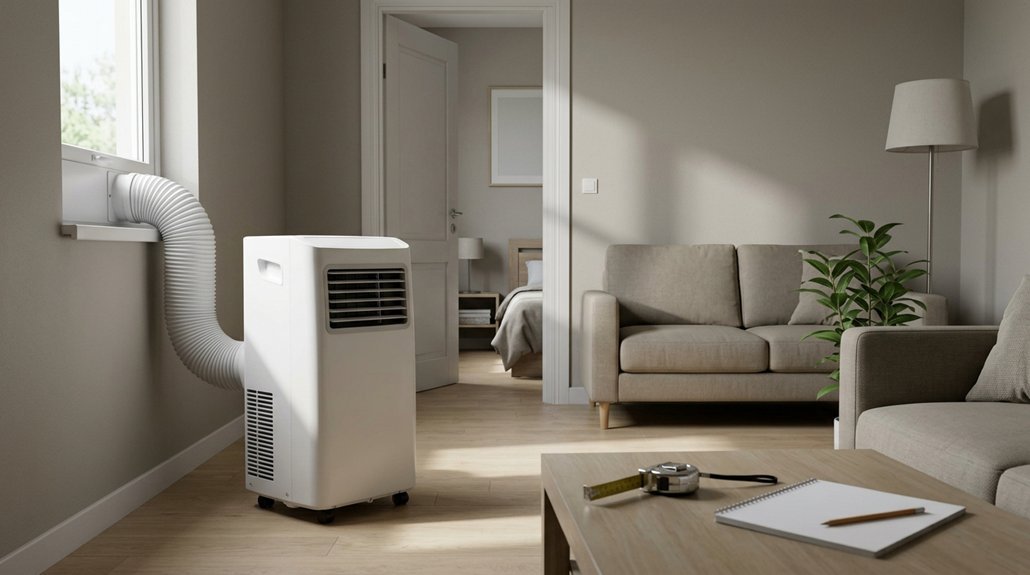
Sizing a portable air conditioner starts with your room’s square footage: multiply length by width, then compare that figure to a unit’s cooling capacity. BTUs are the standard measure of cooling power, but the SACC rating gives a more realistic picture of what a portable unit can actually handle in everyday conditions.
Several factors can push your cooling needs higher than square footage alone suggests. Sun-facing windows, high ceilings, weak insulation, and additional occupants in the room all increase the load a unit has to manage. Choosing a size that ignores these details often leads to disappointing performance or unnecessary energy use.
Getting the size wrong in either direction has real downsides. An undersized unit will run constantly and still struggle to cool the space, while an oversized one may cycle on and off more than needed, wasting energy without meaningfully improving comfort. Working through the factors below can help narrow down the right capacity for your specific room.
Key Takeaways
What Size Portable Air Conditioner Do I Need?
Start by measuring the room’s length and width, then multiply those figures to get the square footage. This number is the starting point for sizing a portable air conditioner correctly.
For rooms with standard 8-foot ceilings, typical baseline recommendations are 8,000 BTU for 200 square feet, 10,000 BTU for 300 square feet, and 12,000 BTU for 400 square feet. These figures offer a general guide rather than an exact formula, since room conditions vary.
When comparing units, check the SACC (Seasonally Adjusted Cooling Capacity) rating rather than relying on the advertised BTU number alone. SACC ratings tend to reflect real-world cooling performance more accurately, since the standard BTU figure can overstate a portable air conditioner’s actual capacity.
Certain room conditions call for additional cooling capacity. Adding roughly 10 to 20 percent more capacity is generally recommended for rooms with strong sun exposure, poor insulation, tall ceilings, large windows, or heat-generating electronics like computers or entertainment systems.
Occupancy matters too. For each regular occupant beyond two people, adding 600 to 1,000 BTUs of capacity helps account for the additional heat generated by body warmth.
It’s worth avoiding the temptation to oversize a unit as a safety margin. A portable air conditioner that’s too powerful for the room can cool the space too quickly without adequately removing humidity, leaving the air feeling damp rather than comfortable.
How to Size a Portable Air Conditioner
Start with the room itself. Measure its length and width in feet, then multiply the two numbers to find the square footage. This gives you a practical baseline for sizing portable cooling before factoring in anything else.
Most sizing charts assume an 8-foot ceiling. Once you know the square footage, you can match it to a BTU-per-hour range designed to handle that space without running the unit harder than necessary or leaving it underpowered. For example, a room up to 400 square feet typically pairs well with a 9,000 BTU unit, while larger spaces need proportionally more cooling power.
From there, it helps to adjust for real-life heat gain:
- If the ceiling is higher than 8 feet, add capacity based on room volume rather than floor area alone.
- For rooms with sunny windows, weak insulation, or heat-producing electronics, increase capacity by roughly 10 to 20 percent.
- For each person beyond two who regularly occupies the room, add about 600 to 1,000 BTUs.
A unit sized to the room’s actual cooling load, rather than just its square footage, is more likely to maintain steady comfort.
Undersized units tend to run constantly without fully cooling the space, while oversized units can cycle on and off quickly, which affects humidity control.
If you’re comparing specific models, our portable air conditioner buying guide breaks down capacity ranges and features across different room sizes.
Portable AC BTU Chart by Room Size
A room-size chart gives you a quick starting point for choosing portable AC capacity, especially if your space has standard 8-foot ceilings.
Match your room’s square footage to these general targets:
- 200 square feet: 8,000 BTU
- 300 square feet: 10,000 BTU
- 400 square feet: 12,000 BTU
- 500 square feet: 14,000 BTU
These figures work best as a baseline rather than an exact formula, since factors like sun exposure, ceiling height, and insulation can shift the ideal capacity up or down.
It’s also worth checking the unit’s SACC rating before deciding.
SACC reflects a more realistic cooling capacity under standard test conditions and is often lower than the BTU number printed on the box.
When comparing options, look at the listed SACC alongside room size rather than relying on BTU alone, since two units with the same BTU rating can have different SACC values.
Use the chart as a starting reference, then compare specific models based on their listed SACC, dimensions, and features to find one suited to your room.
This approach helps you avoid choosing a unit that looks powerful on paper but underperforms in daily use. Beyond capacity, it’s worth factoring in indoor air quality needs when selecting a portable AC, since some models offer added filtration benefits that can improve comfort in the room.
What Changes the BTU Size You Need?
Beyond square footage, a room’s heat load determines whether a portable AC feels comfortably capable or struggles to keep up. Room area is a useful starting point, but the BTU rating should be adjusted upward for conditions that add heat.
Higher ceilings mean more air volume to cool. Much like standard CADR ratings, most BTU sizing charts assume an 8-foot ceiling, so rooms with taller ceilings require volume-based calculations rather than square footage alone. Poor insulation lets outdoor heat enter more easily. Direct sun exposure through large windows can increase cooling demand, particularly in rooms that face afternoon sun.
Internal heat sources matter as well. People, ovens, bright lighting, gaming PCs, and servers all add warmth to a space, which raises the effective cooling load beyond what square footage alone suggests.
A higher SACC-rated capacity makes sense when several of these factors apply at once. That said, sizing a unit far beyond what the room needs isn’t necessarily better, since an oversized unit can cool the air quickly while removing less humidity, which may leave the room feeling cool but damp.
How Sun, Insulation, and Room Layout Affect Sizing
Sunlight, insulation, and the shape of your space can all affect how well a portable AC keeps up with a room. A unit sized correctly on paper may still struggle if these factors aren’t taken into account.
Rooms that get strong direct sun for much of the day generally need more cooling capacity than the standard BTU guidelines suggest. A common approach is adding about 10% to the baseline recommendation, particularly when the room has large south- or west-facing windows.
Poor insulation, thin walls, and single-pane glass increase cooling demand as well, sometimes adding another 10% to 20% on top of the base calculation. Window area matters too, since more glass exposed to sunlight typically means more heat entering the room. It’s worth comparing BTU ratings against your actual room conditions rather than relying on floor space alone.
Ceiling height and room shape play a role too. Taller ceilings mean more air volume to cool, while an open or irregularly shaped layout can create warm spots that are harder for a single unit to reach. Appliances, lighting, and electronics in the room add to the cooling load as well, since they generate heat during use. Humidity levels also factor into comfort, and pairing an AC with a unit that has strong moisture removal rates can help maintain a balanced environment in spaces prone to dampness.
These factors are worth keeping in mind when comparing specific portable AC models and their BTU ratings, since two rooms of the same square footage can have very different cooling needs.
Avoid a Portable AC That’s Too Big or Small
Getting the size right matters. Based on the specifications, a portable AC that’s too small will run nonstop without making a room comfortable, while one that’s too large may cool the air so quickly that it doesn’t remove enough moisture, leaving the space feeling damp.
Matching BTU and cooling power to the size of a space is the starting point, but real-life heat loads should factor into the decision too.
General BTU guidelines by square footage:
- 8,000 BTU is generally suited to about 200 square feet.
- 10,000 BTU is generally suited to roughly 300 square feet.
- 12,000 BTU is generally suited to around 400 square feet.
- For rooms with significant sun exposure, large windows, or multiple electronics, adding 10-20% more cooling capacity is a reasonable adjustment.
Choosing a unit sized correctly for the space helps it dehumidify properly and avoid the clammy, stop-start cooling cycles that come from an oversized unit.
It also tends to support better energy efficiency over time, since a properly sized AC won’t be working harder than necessary. Comparing listed specifications against actual room size before buying is a more reliable approach than estimating. Much like verifying air changes per hour ratings when sizing an air purifier, checking how quickly a portable AC can cycle the air in a given space provides a clearer picture of its true cooling effectiveness than square footage alone.
Frequently Asked Questions
How Big of a Room Will a 10,000 BTU Portable AC Cool?
A 10,000 BTU portable AC will typically cool a room between 300 and 450 square feet, assuming standard 8-foot ceilings. Where your room falls in that range depends on several factors. Rooms with poor insulation, large or south-facing windows, or heavy sun exposure tend to need more cooling power, pushing the effective coverage closer to 300 square feet. The same is true for spaces that generate extra heat from cooking appliances, electronics, or having multiple people in the room regularly. On the other hand, well-insulated, shaded rooms with minimal heat sources can reach the higher end of that range. Because performance varies by model and room conditions, it’s best to treat 300–450 square feet as a general guideline rather than an exact figure.
How Many Square Feet Will a 12000 BTU Portable Air Conditioner Cover?
A 12,000 BTU portable air conditioner typically covers up to 400 square feet in a room with 8-foot ceilings and average insulation. In rooms that get a lot of direct sun, have poor insulation, higher ceilings, or contain multiple heat-generating appliances, actual coverage often drops to around 320 to 360 square feet. The number of people regularly in the space can also reduce effective cooling area, since body heat adds to the cooling load. Because performance depends on the specific unit and room conditions, these figures should be treated as general estimates rather than guaranteed results. Checking the manufacturer’s specifications for a particular model can help confirm expected coverage before purchasing.
Do All Portable Air Conditioners Need to Be Vented Out a Window?
Yes, nearly all portable air conditioners require venting to the outside, typically through a window kit included with the unit. This hose expels hot air generated during the cooling process, so blocking or skipping it will reduce performance significantly. While windows are the most common venting method, some hoses can be adapted for sliding doors or, in certain cases, through a wall with the right kit. One exception is ventless evaporative coolers, which use water to cool air instead of a refrigerant cycle and don’t require outdoor venting. However, these work differently than standard portable AC units and are generally less effective in humid climates. If you’re shopping for a portable air conditioner, check the specifications to confirm venting requirements for that particular model.
Is 5000 BTU Enough for a Bedroom?
Yes, 5,000 BTU is generally enough for a bedroom around 100 to 150 square feet with standard ceiling height. This size unit can adequately cool a typical small to medium bedroom under normal conditions.
However, several factors can increase your cooling needs. If your room gets strong direct sunlight, has poor insulation, houses multiple people, features high ceilings, or contains heat-generating electronics like computers or TVs, you may need a stronger unit in the 6,000 to 8,000 BTU range. Room layout and local climate can also affect performance, so consider these variables when deciding if 5,000 BTU will meet your specific needs.