
HEPA vs Activated Carbon Filters Explained
Many air purifiers list “HEPA + carbon” on the label, which can make the product seem more complex or expensive than it needs to be. These two filter types do not compete with each other. Instead, they handle separate jobs.
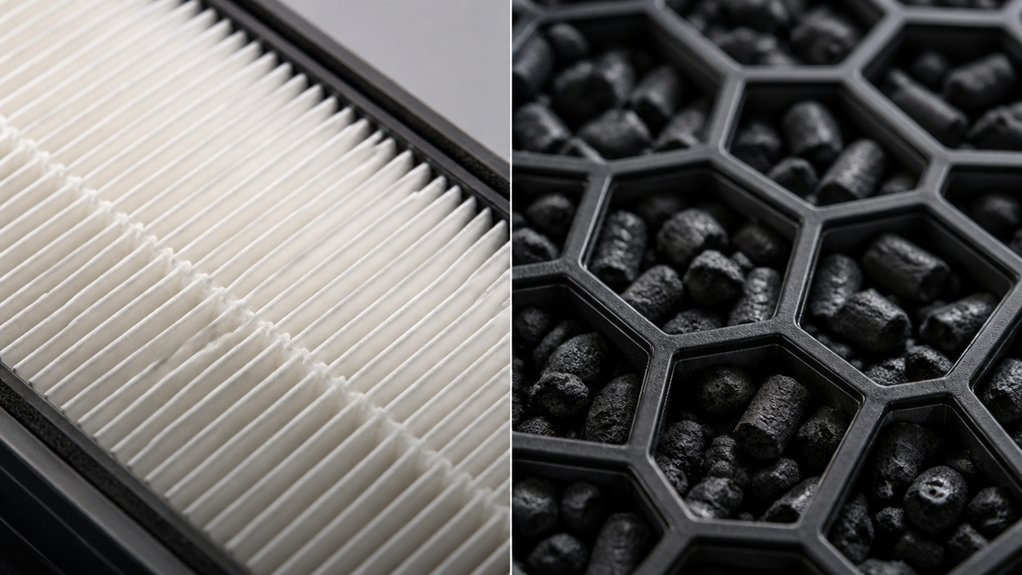
A HEPA filter is designed to capture airborne particles such as dust, pollen, and pet dander. An activated carbon filter is designed to address gases and odors, including smoke and cooking smells. Confusing the two purposes can lead someone to choose a purifier that is not suited to the specific issue they are trying to solve.
Understanding this difference makes it easier to match a purifier to actual air quality concerns rather than relying on the filter label alone.
Key Takeaways
HEPA vs Activated Carbon Filters Explained
These two filter types solve different problems, which is why the distinction matters when choosing an air purifier.
HEPA filters use mechanical filtration, trapping particles like dust, pollen, and pet dander in fine fiber mats. As air passes through, particles get physically caught in the dense web of fibers.
Activated carbon works differently. It relies on adsorption, a process where gases, odors, and volatile organic compounds (VOCs) bind to the carbon’s porous surface. This makes it effective against smells and certain chemical vapors that HEPA filters simply pass through.
The core trade-off comes down to what each filter can and cannot do. HEPA excels at particulates but has no effect on gases or odors, while activated carbon adsorbs gases but leaves airborne particles untouched. Neither filter type covers both jobs on its own.
For particle protection specifically, the HEPA rating matters. True HEPA filters, rated H13 or H14, are the standard most associated with capturing very fine particles such as smoke, and manufacturers of these products typically publish specific efficiency claims. Products labeled only as “HEPA-like” or “HEPA-type” generally don’t carry the same tested efficiency standards, so it’s worth checking the specific rating listed rather than relying on the general term.
Many air purifiers combine both filter types to address particulate and odor concerns in one unit. This layered approach is common in models designed for general household use, since it covers a broader range of air quality issues than either filter alone. If you’re comparing specific purifiers, our air purifier buying guide breaks down which combination filters offer the best balance for different room sizes and budgets.
What’s the Difference Between HEPA and Activated Carbon Filters?
These two filters solve different problems, and understanding the distinction can help you avoid paying for capabilities you don’t actually need.
A HEPA filter works mechanically. It’s a dense mat of fine fibers that physically traps particulate matter (PM2.5), pollen, dust, mold spores, and pet dander as air passes through. Nothing about the process is chemical, it’s pure physical filtration. True HEPA or H13 filters are rated to capture at least 99.97% of particles between 0.1 and 0.3 microns, making them the benchmark for mechanical filtration performance.
Activated carbon filters take a different approach. Rather than trapping solid particles, they adsorb gas molecules, pulling volatile organic compounds (VOCs), smoke, and cooking odors into a network of microscopic pores.
Carbon’s effectiveness depends heavily on how much material is present and how deep the filter bed is. Thin carbon sheets, the kind bundled into combination filters, tend to offer limited odor control.
Filters with genuine depth and mass generally hold up better over time, though replacement frequency still matters for maintaining performance.
Which Filter Type Do You Actually Need?
Now that you know how these two filters actually work, the real question is what’s floating around in your air. Dust and pet dander point to one solution. Cooking smells and paint fumes point to another. Here’s a quick breakdown to help match the filter to the problem:
| Your Problem | Best Solution | Why It Works |
|---|---|---|
| Dust, pollen, mold | HEPA filter | Traps particles down to 0.3 microns |
| Smoke, VOCs, odors | Activated carbon | Adsorbs gas molecules directly |
| Wildfire smoke and smell | Both combined | Each filter handles a different type of pollutant |
| Mild new-furniture smell | Light carbon layer | Suited to temporary off-gassing |
| Heavy smoke or VOC load | Higher carbon mass | More carbon generally means more capacity, regardless of marketing labels |
The key is matching the filter to the actual problem in your space rather than relying on general marketing claims. For the most serious airborne threats like smoke and viruses, look specifically for true HEPA filters rated H13 or H14 rather than generic HEPA-style labels. If you’re unsure which category applies, our guide comparing HEPA-only and combination units can help narrow down the right type for your situation.
How Do HEPA Filters Trap Particles and Allergens?
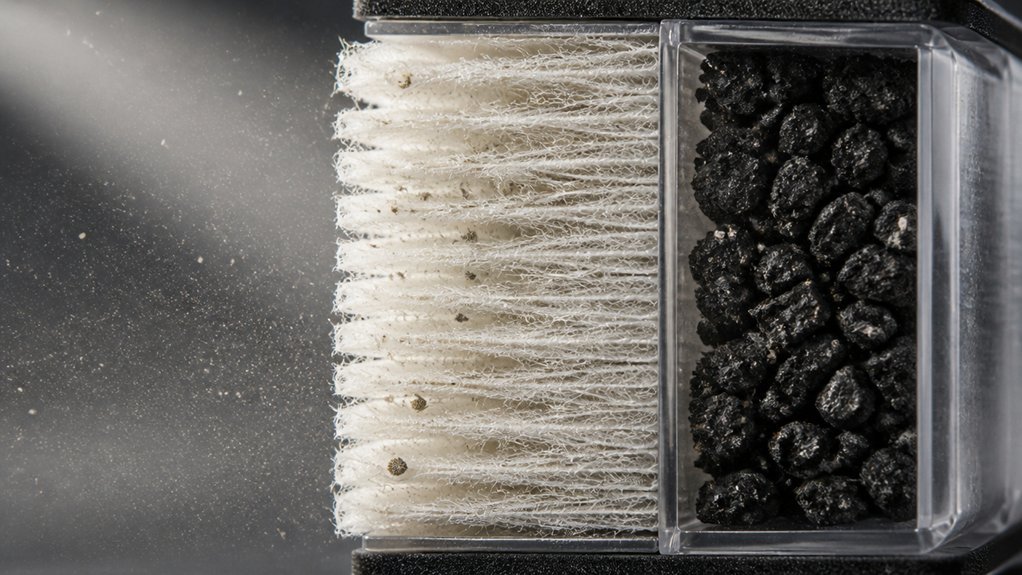
A HEPA filter works more like a dense, tangled maze of fine woven fibers than a screen with holes punched in it. That maze structure is where particle capture actually happens, and the process is entirely mechanical rather than a single filtering action.
Three mechanisms work together inside the fiber maze. Larger particles collide directly with fibers through impaction. Mid-sized particles get caught through interception, brushing against fibers as air curves around them. The smallest particles move erratically due to diffusion, bouncing around until they eventually stick to a fiber.
This combination of impaction, interception, and diffusion is why true HEPA filters are rated to capture 99.97% of particles at 0.3 microns, a size range that’s generally considered the hardest to filter. Particles both larger and smaller than 0.3 microns tend to be captured more easily, since bigger particles are stopped by impaction and smaller ones are more affected by diffusion. This fiber-maze design is a core feature to evaluate when comparing indoor air quality products like air purifiers, since filtration efficiency directly impacts how well allergens and pollutants are removed from your home.
Understanding this mechanical process matters when comparing air purifiers or vacuum filters, since not every filter labeled “HEPA-type” or “HEPA-like” meets the same standard. For a closer look at how filter ratings differ across product categories, see our related buying guides on air purifiers and vacuum filtration systems.
How Does Activated Carbon Remove Odors and Gases?
The fiber maze in HEPA filters handles particles well, but it does nothing for the smell of last night’s fish dinner lingering in the kitchen. Odors and gases pass right through as vapor, too small and too chemically different for a mechanical filter to catch. This is where activated carbon comes in, using a process called adsorption to attract gas molecules and hold them on its surface.
Activated carbon is processed to have an extremely porous structure, giving it a large surface area relative to its size. As air passes through, odor molecules and volatile organic compounds (VOCs) stick to that surface instead of continuing on with the airflow.
A few factors affect how well activated carbon performs:
- Filter bed depth matters, since more carbon means more contact time and more opportunities for odor molecules to be captured
- Thicker carbon blocks tend to handle stronger or ongoing odor sources better than thin carbon layers
- Carbon saturates over time as its pores fill up, so regular replacement is part of normal maintenance
- Performance depends on airflow and the specific odors involved, so results can vary by use case
Carbon filters work well for cooking smells, smoke, and general VOCs, but they aren’t designed to capture particles like dust or pollen. That’s typically handled by a separate HEPA stage in combination units. Readers comparing air purifiers with odor control may want to look at models that pair both filter types, since particle filtration and gas adsorption serve different purposes. Since excess humidity can also worsen musty smells and mold growth, pairing an air purifier with a dehumidifier that carries an ENERGY STAR certification can help manage both odor sources and moisture levels more efficiently.
Why Pairing HEPA and Carbon Filters Works Best
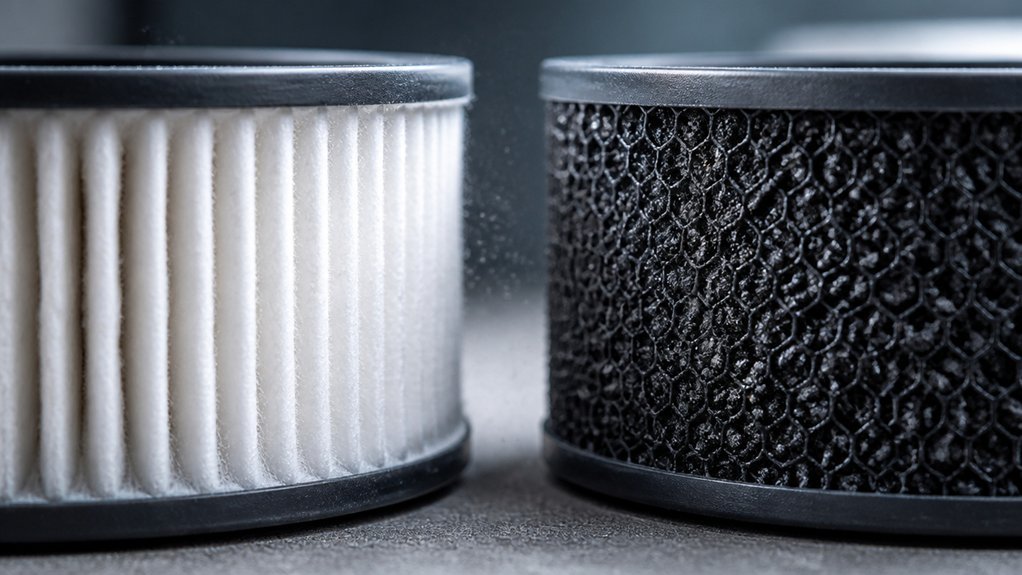
No single filter handles every air quality problem. HEPA filters capture particulate matter such as dust, pollen, and pet dander, but gases pass through them unaffected. Activated carbon addresses VOCs and odors while leaving solid particles untouched. Using both together covers a wider range of air quality concerns than either can address alone. Many robot vacuums and cordless vacuums also rely on HEPA filtration to trap allergens picked up from floors, making it a familiar technology across both air purifiers and cleaning equipment.
A few practical points matter when comparing options:
- Carbon quantity affects performance: thin carbon sheets offer limited odor control, while units with several pounds of carbon are better suited to persistent odor problems.
- Combined HEPA-carbon units simplify setup and take up less space, while separate units allow each component to be sized or replaced independently.
- Denser carbon filters typically increase airflow resistance, which the listed specifications often address through a stronger fan motor.
Buyers should weigh how much space they have, whether they’re dealing with odors, particles, or both, and how often they’re willing to replace filters.
Combined units tend to work well for smaller spaces or simpler setups, while separate components suit those who want more control over filtration strength or replacement schedules. For side-by-side comparisons of specific models, our air purifier buying guides break down capacity, filter types, and maintenance requirements in more detail.
Frequently Asked Questions
Is an Activated Carbon or HEPA Filter Better?
Neither type is universally better, since each targets a different problem. HEPA filters are designed for dust, pollen, and pet dander, while activated carbon is better suited to odors, smoke, and VOCs.
If you’re dealing with both particles and odors, a combination unit that includes both filter types may be worth considering.
What Are the Disadvantages of an Activated Carbon Filter?
Activated carbon doesn’t trap particles like dust and pollen, so it won’t help with those allergens. Effective odor control typically requires thick, multi-pound layers of carbon media, which increases airflow resistance compared to thinner filters. Carbon also becomes saturated over time and generally needs replacement every 3 to 6 months, adding to ongoing maintenance costs.
What Can HEPA Filters Not Filter Out?
HEPA filters address particles, not gases. Odors, volatile organic compounds like formaldehyde, and smoke smell pass through a HEPA filter largely unaffected, since these are gas-phase contaminants rather than solid particles.
The same limitation applies to sulfur and nitrogen compounds, combustion byproducts, ozone, and radon decay products. Filtering these out requires activated carbon or another gas-adsorbing media, since HEPA construction has no mechanism for capturing them.
For households concerned about odors or chemical off-gassing in addition to particulates, an air purifier that pairs a HEPA filter with an activated carbon layer is generally a better fit than a HEPA-only unit.
Should I Install an Activated Carbon Filter Before or After a HEPA Filter?
The correct order depends on the setup. A thick carbon layer placed before the HEPA filter helps protect it from larger particles and reduces odors before air reaches the HEPA stage. Granular carbon placed after the HEPA filter can help prevent fouling and may extend the carbon’s usable life, since the HEPA stage removes particulates first.
Either configuration can work, but airflow matters. It’s worth checking the fan’s capacity to ensure it can push air through both filter stages without a significant drop in performance.