
You walk into a store—or scroll through an endless list online—and every air purifier claims to cover “up to 500 square feet.” But your room isn’t a showroom, and that number doesn’t account for your ceiling height or how often you actually want the air cycled. Getting the size right takes a bit more than square footage. Here’s where you start.
Key Takeaways
- Measure your room’s length and width in feet, then multiply to get square footage.
- For ceilings above 8 feet, calculate room volume (length × width × height) instead of square footage.
- Use the rule of thumb: required CADR ≈ two-thirds of room square footage for an 8 ft ceiling.
- For precise sizing, calculate CADR as (room volume × desired ACH) ÷ 60.
- Target 4–6 ACH depending on needs, then choose a purifier rated slightly above your calculated CADR.
Measure Your Room’s Square Footage First
Before you buy an air purifier, grab a tape measure and find your room’s length and width in feet, then multiply them to get square footage. For example, a 12 ft by 10 ft room gives you 120 square feet. This number becomes your baseline for determining room size and choosing the right unit.
Don’t stop at floor space, though. Check your ceiling height, too. Standard CADR ratings assume an 8-foot ceiling, so if yours is taller, you’ll need to calculate room volume instead of relying on square footage alone. Multiply length, width, and height in feet to get cubic footage.
This extra step matters because taller rooms hold more air, requiring a purifier with higher capacity to clean it effectively. As a general rule, you should aim for at least 4–5 air changes per hour to ensure your space gets properly refreshed throughout the day.
Understand CADR Ratings for Air Purifiers
Once you’ve got your square footage in hand, you’ll need to understand what CADR actually means. CADR, or clean air delivery rate, measures how much filtered air a purifier delivers for smoke, pollen, and dust, expressed in cubic feet per minute (CFM). Higher CADR means faster particle removal. Always check the AHAM-verified CADR on packaging or ENERGY STAR listings—it’s lab-tested and comparable across brands, unlike marketing room-size claims.
As a rule of thumb, your required CADR should be roughly two-thirds of your room square footage, assuming an 8 ft ceiling. If you want higher air changes per hour, though, calculate CADR based on room volume times your target ACH instead. Keep in mind CADR is measured at top fan speed and doesn’t address odors or gases. This is similar to how portable air conditioners are rated by BTU rating to match their cooling capacity with a room’s square footage.
Adjust CADR for Ceiling Height and ACH
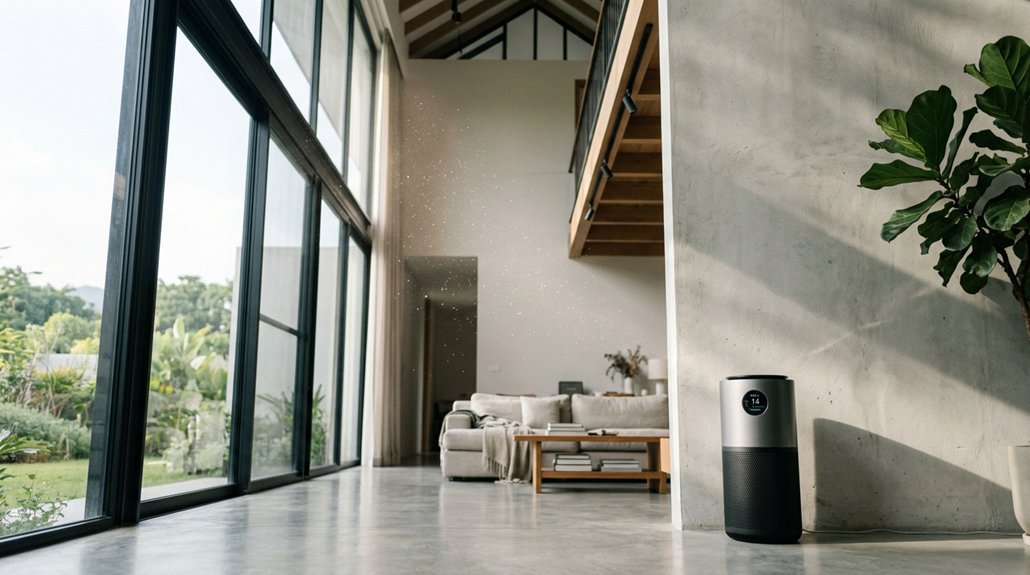
The two-thirds rule works fine for standard 8-ft ceilings, but you’ll need to adjust the math for anything taller or shorter. Since CADR calculation assumes 8 ft, multiply your baseline CADR by (ceiling height ÷ 8) to account for extra room volume. For precise sizing, calculate ACH (air changes per hour) directly: Required CADR = (room volume × desired ACH) ÷ 60. A 12×15×9 ft room targeting 4.8 ACH needs about 129.6 CFM.
| Ceiling Height | Volume Multiplier | Adjusted CADR Factor |
|---|---|---|
| 8 ft | 1.0 | Baseline |
| 9 ft | 1.13 | +13% |
| 10 ft | 1.25 | +25% |
For infection control, target 5–6 ACH, boosting CADR requirements up to 25% higher than standard. Just as dehumidifiers span a wide noise range from whisper-quiet 28 dB models to louder high-capacity units near 47 dB, larger air purifiers needed to meet higher ACH targets may run louder, so factor sound output into your sizing decision.
Calculate the CADR Your Air Purifier Needs
Grab your tape measure and calculator: to find your exact CADR requirement, multiply room volume (length × width × height) by your target ACH, then divide by 60. This gives you CADR in CFM. Aim for at least 3 ACH (air changes per hour), though AHAM recommends 4.8 as a baseline, with 5–6 ACH better for classrooms, workplaces, or infection control.
No time to measure ceiling height? Use square footage instead: CADR ≈ square footage × (ACH ÷ 7.5), or the simpler two-thirds rule (200 sq ft × 0.67 ≈ 133 CFM).
Once you’ve got your number, choose a true HEPA filter paired with activated carbon, and pick a unit rated slightly above your calculated CADR for quieter, more efficient operation.
Choose a True HEPA Air Purifier That Matches
Not all HEPA labels mean the same thing, so you’ll want to check the fine print before you buy. Skip anything labeled “HEPA-like” or “HEPA-type”—only true HEPA (H13 or H14 for smoke and viruses) actually filters what it claims.
Once you’ve calculated your room volume and desired ACH, match that number to a purifier whose AHAM-verified CADR meets or beats your target. Don’t settle for the bare minimum; a higher CADR lets you run lower, quieter fan speeds while still hitting your ACH goal. For bedroom or nursery placement, look for a noise rating in the 24 to 30 decibel range, which is generally considered whisper-quiet enough for uninterrupted sleep.
If odors or VOCs bother you, add an activated carbon stage alongside the true HEPA filter—carbon needs replacing roughly every three months, while HEPA filters typically last six to twelve.
Maintain Your Air Purifier’s Full CADR Power
Buying the right CADR won’t help if you let the filter clog—swap your true HEPA filter on the manufacturer’s schedule, typically every 6 to 12 months, since dust and debris buildup chokes airflow and drags down performance. Clean pre-filters monthly, too; they catch large particles before they overwhelm your HEPA layer. Just as washable pre-filters on cordless vacuums need regular upkeep to maintain suction, your purifier’s filtration system relies on multi-stage filtration staying unclogged to keep capturing 99.9% or more of airborne particles. Keep intakes and outlets clear—blocked vents starve the fan and cut CADR fast. Running your unit continuously at moderate speed also preserves long-term performance and cuts noise.
| Maintenance Task | Frequency |
|---|---|
| Replace true HEPA filters | 6–12 months |
| Clean/vacuum pre-filters | Monthly |
| Check intake/outlet clearance | Weekly |
| Verify airflow after filter swap | Each replacement |
After replacing filters, confirm restored airflow to make certain your purifier’s still hitting its rated CADR.
Frequently Asked Questions
Is It Better to Have One Big Air Purifier or Several Small Ones?
It depends—for large or open spaces, you’ll often get better results using several small units placed near pollutant sources, since their combined CADR can exceed one big purifier’s, while running quieter and more efficiently.
How Many Air Purifiers Do I Need for a 2000 Sq Ft House?
You’ll typically need about four purifiers, each rated around 320 CFM CADR, to reach the 1,280 CFM total your 2,000 sq ft house requires at 4.8 ACH—placing one in each main room.
What Is the 2/3 Rule for Air Purifiers?
You take your room’s square footage and multiply it by two-thirds to get your target CADR in CFM. So for a 200 sq ft room, you’d want roughly 133 CFM, assuming an 8 ft ceiling.
What Size Air Purifier Do I Need for a 300 Sq Ft Room?
You’ll want a CADR of at least 200 CFM for a 300 sq ft room with 8 ft ceilings. For better results, aim for 200-240 CFM to hit 5-6 ACH, especially if you have allergies.