
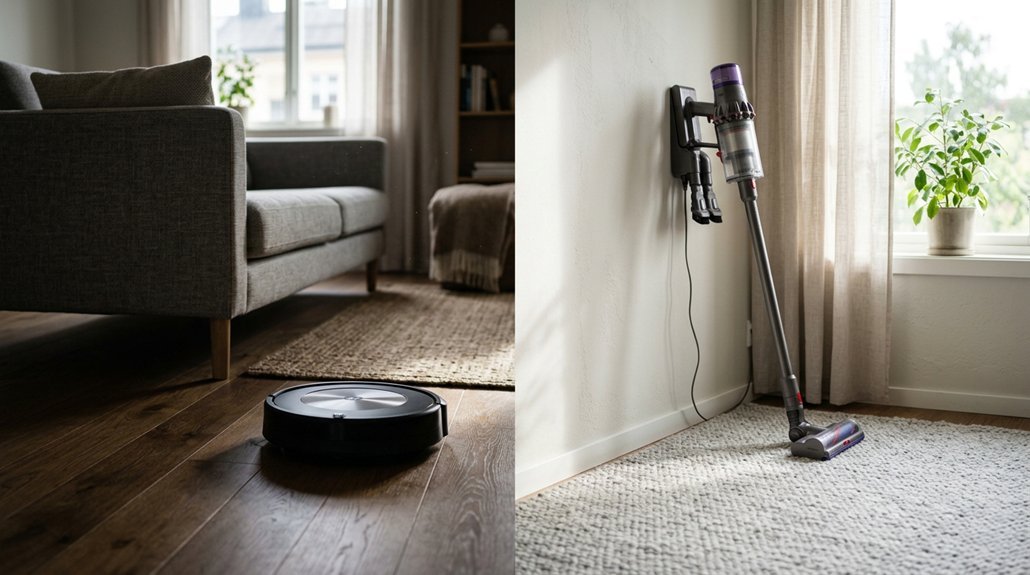
You’re standing in the vacuum aisle, torn between a robot that promises hands-off convenience and a cordless stick that delivers serious suction power. Both claim to solve your cleaning headaches, but they work in completely different ways. Before you swipe your card, you’ll want to know which one actually fits your home, your floors, and your daily routine.
Key Takeaways
- Robot vacuums automate daily cleaning with sensors and LiDAR, while cordless vacuums require manual steering and control.
- Cordless models like the Dyson V15 offer higher raw suction (10,000–25,000+ Pa) for deep, single-pass cleaning.
- Robots excel at maintaining hardwood and tile floors daily, but cordless vacuums handle stairs and upholstery better.
- Robot vacuums cost $400–$1,000+, while cordless options range from $200–$500, appealing to budget-conscious buyers.
- Pairing both ensures consistent maintenance from robots and deep-cleaning power from cordless vacuums.
Robot Vacuum vs Cordless Vacuum: What’s the Real Difference?
At their core, robot vacuums and cordless vacuums tackle cleaning from two different angles. A robot vacuum works autonomously, using sensors and LiDAR to map your home and run scheduled cleaning sessions without you lifting a finger. Models like the DEEBOT series even offer no-go zones and app control, sliding under furniture to catch pet hair daily.
A cordless vacuum, on the other hand, puts you in control. You steer it manually, tackling stairs, upholstery, and deep cleaning carpets with concentrated suction power—think the Dyson V15‘s 60-minute runtime for intensive sessions. Many cordless models now boast runtimes up to 70 minutes on lower power settings, giving you ample time to clean an entire home in one go.
Essentially, robot vacuums handle maintenance, while cordless vacuums deliver hands-on power. One automates your routine; the other gives you precision when you need it most.
Which One Cleans Better: Robot or Cordless?
Strip away the marketing specs, and the real answer hinges on what “clean” means to you. If you want consistent daily maintenance—keeping dust and pet hair from piling up—a robot vacuum wins by running on autopilot every day.
But if you need raw suction power for deeply embedded dirt, cordless stick vacuums take the lead, with many models claiming 10,000–25,000+ Pa in lab tests.
Some advanced robots, like the DEEBOT X11 OmniCyclone, push close to cordless-level suction, but they still rely on multiple passes rather than one strong sweep. Models like the dreame D30 Ultra reach up to 25,000 Pa of suction, narrowing the gap between robot and cordless performance. For stairs, upholstery, and stubborn spills, cordless wins outright. For everyday upkeep across floors, the robot vacuum simply can’t be beaten.
Which Vacuum Wins on Pet Hair and Carpets?
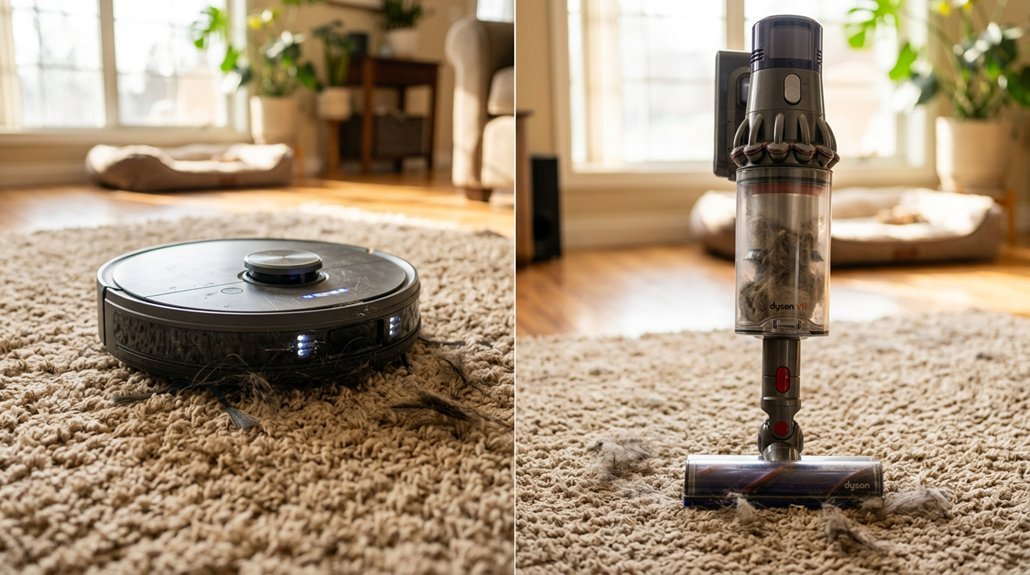
Pet hair separates winners fast: if you’re battling daily shedding across hardwood and tile, a robot vacuum with tangle-free brushes—like the DEEBOT X11 OmniCyclone’s ZeroTangle 3.0—handles it on autopilot, running scheduled passes so hair never piles up. But carpets tell a different story. Embedded dander and long fibers need raw suction, and cordless vacuums pull ahead here—ROMO’s 25,000 Pa and the Dyson V15’s targeted power extract what robots often miss in one pass. For deeper carpet refreshes beyond vacuuming, upright cleaners with five counter-rotating brushes can agitate fibers to dislodge the stubborn dirt and pet dander that suction alone leaves behind.
| Task | Robot Vacuum | Cordless Vacuum |
|---|---|---|
| Daily pet hair | Excellent (ZeroTangle 3.0) | Good, but manual |
| Carpets/dander | Strong (19,500 Pa) | Best (up to 25,000 Pa) |
| Upholstery/stairs | Limited | Excellent |
For total control, pair both.
How Do Robot and Cordless Vacuum Costs Compare?
Break down the price tags, and a clear pattern emerges: robot vacuums typically run $400 to over $1,000, with advanced mapping and self-empty docks pushing costs toward that upper range—often nearly double what you’d pay for a comparable cordless stick.
You’ll find cordless models priced between $200 and $500, with budget options dipping under $200, making them the more accessible entry point. Premium robots like the DEEBOT X11 OmniCyclone justify their higher price through self-emptying and AI-powered features.
Your total cost of ownership hinges on usage patterns: cordless vacuums demand battery life management and occasional replacements, while robots require upkeep for bags and mop pads. Much like air purifiers, which typically need filter replacement intervals of three to twelve months to maintain peak performance, vacuums also incur ongoing costs tied to how often their filters or batteries must be swapped out.
If you’re busy, a robot’s automation offsets its steeper cost.
How Much Daily Effort Does Each Vacuum Require?
How Much Daily Effort Does Each Vacuum Require?
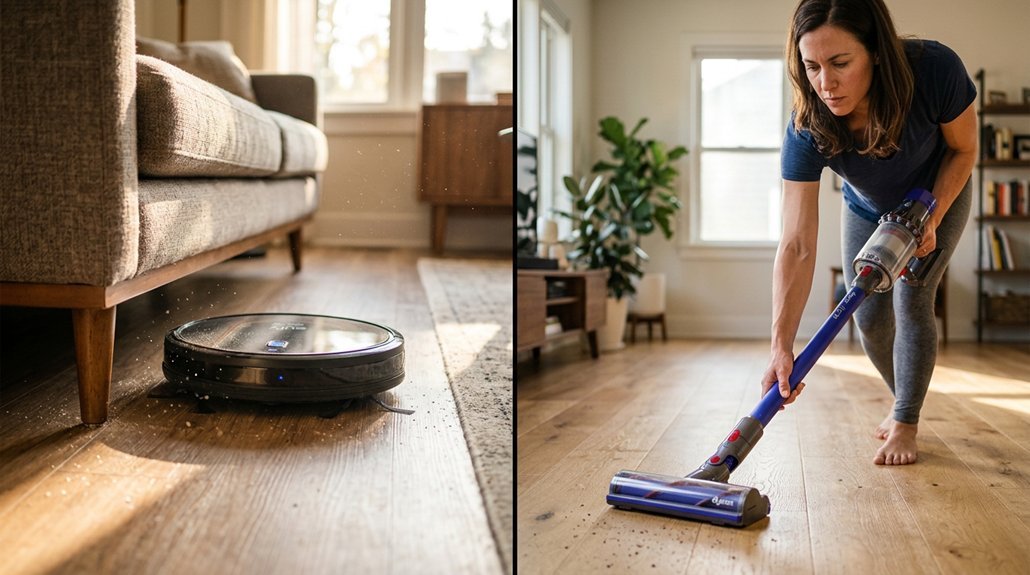
Beyond the price tag, your day-to-day involvement with each vacuum looks completely different. Robot vacuums thrive on minimal human intervention—you set a schedule once in the app, and it handles daily dust on autopilot, docking itself to recharge or self-empty.
Your only real commitment is upfront setup: mapping your home, marking no-go zones, and clearing clutter so it doesn’t get stuck.
Cordless vacuums require manual effort every time you clean. You’ll pick it up, steer it room to room, and empty the dustbin after each session.
Longer cleaning sessions may mean recharging or swapping batteries mid-task. Maintenance effort also differs—robots need occasional brush and sensor cleaning, while cordless models need filters cleaned and bins emptied constantly. This hands-off scheduling is similar to how some countertop dishwashers offer a delay start feature, letting users queue up a cleaning cycle in advance rather than manage the process in real time.
Frequently Asked Questions
Should I Get a Robot Vacuum or a Stick Vacuum?
Get a robot vacuum if you want hands-free daily upkeep on hard floors. Choose a cordless stick for stronger suction on carpets, stairs, and upholstery. Ideally, you’ll use both for complete, effortless coverage.
Are Robot Vacuums Really Worth the Money?
Yes, if you value hands-free convenience—you’ll save time on daily upkeep with scheduled cleaning and self-docking. But you’ll still want a cordless option for deep-cleaning carpets, stairs, and upholstery when it matters most.
Which Is Better, Dyson or Robot Vacuum?
Neither wins outright—you’ll get stronger suction and control with a Dyson for deep cleans, but you’ll enjoy hands-free daily upkeep with a robot. Pair both for the best results, or pick one based on your priority.
Should I Get a Cordless Vacuum or a Regular Vacuum?
Choose a cordless vacuum if you want portability, quick spot-cleaning, and easy stairs/upholstery access. Pick a regular (corded) vacuum if you need maximum suction, larger dust capacity, and don’t mind less mobility.