
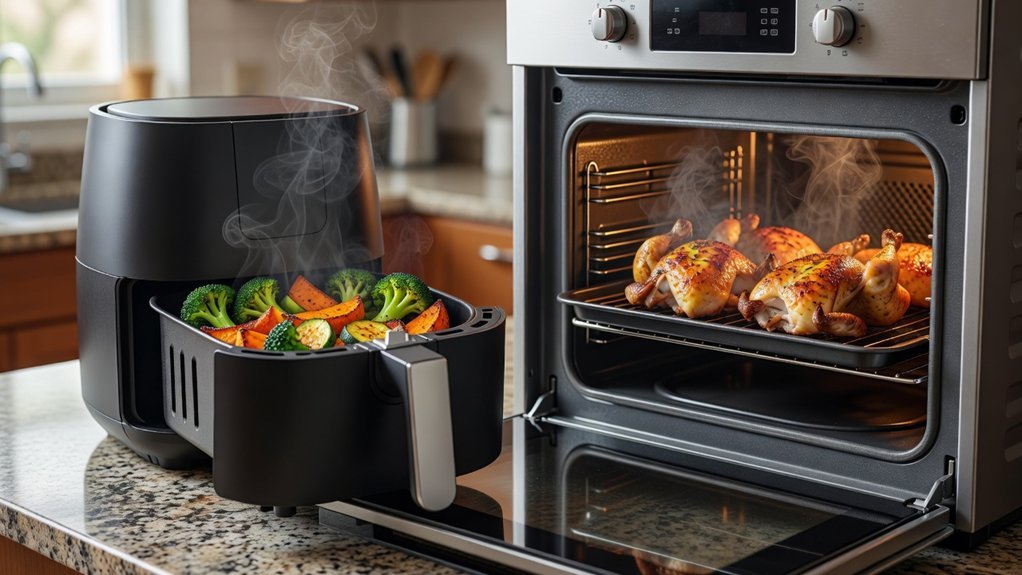
You’ve probably wondered whether your air fryer is just a shrunken-down convection oven with better marketing. It’s a fair question. Both rely on circulating hot air, yet the way they do it—and what that means for your food—sets them apart in ways that affect texture, cooking time, and even what you should be cooking in each. The differences run deeper than size alone suggests.
Key Takeaways
- Both rely on fan-driven convection to crisp and brown food without deep frying in oil.
- Air fryers use compact chambers for faster, crispier results in small batches.
- Convection ovens offer larger capacity, multiple racks, and more even heat distribution.
- Air fryers save time on small portions; convection ovens suit bigger meals better.
- A convection oven with Air Fry mode can replace a standalone air fryer.
How Do Air Fryers and Convection Ovens Actually Cook Food?
Strip away the marketing names, and you’ll find both appliances rely on the same core principle: a fan that circulates hot air to brown food without dunking it in oil. That’s the essence of convection cooking, and air frying simply takes it further.
In an air fryer, you’re working with a compact chamber where the fan sits right above the heating element. This setup concentrates circulating hot air into a tight space, giving you rapid crisping and browning for smaller batches. Some models push this further with TurboBlaze technology, using a 3600 rpm fan to intensify the effect and deliver even more consistent crisping.
A convection oven spreads that same airflow across a larger cavity, often with an exhaust helping move air past multiple racks. You’ll get more even heat distribution, which suits bigger meals better than quick, single-layer crisping jobs.
Are Air Fryers Just Small Convection Ovens?
Because they share the same fan-driven cooking method, it’s tempting to call an air fryer just a shrunken convection oven—but the comparison only goes so far. Both rely on air circulation to cook food, yet an air fryer’s compact chamber places the fan and heating element much closer to your food, intensifying crisping and speeding up browning. A convection oven’s larger cavity trades that concentrated heat for versatility and capacity, letting you roast a full tray of vegetables or bake multiple racks at once. Some hybrid models, like the Cuisinart TOA-70NAS, use an AirAdvantage system to circulate hot air for crisp, speedy results that rival dedicated air fryers while still offering convection oven capacity. Here’s how they stack up:
| Feature | Air Fryer | Convection Oven |
|---|---|---|
| Size | Compact | Large |
| Airflow | Concentrated | Distributed |
| Capacity | 2–6 quarts | Multiple racks |
| Best For | Crisping small batches | Bigger meals |
How Do Speed, Temperature, and Capacity Compare?
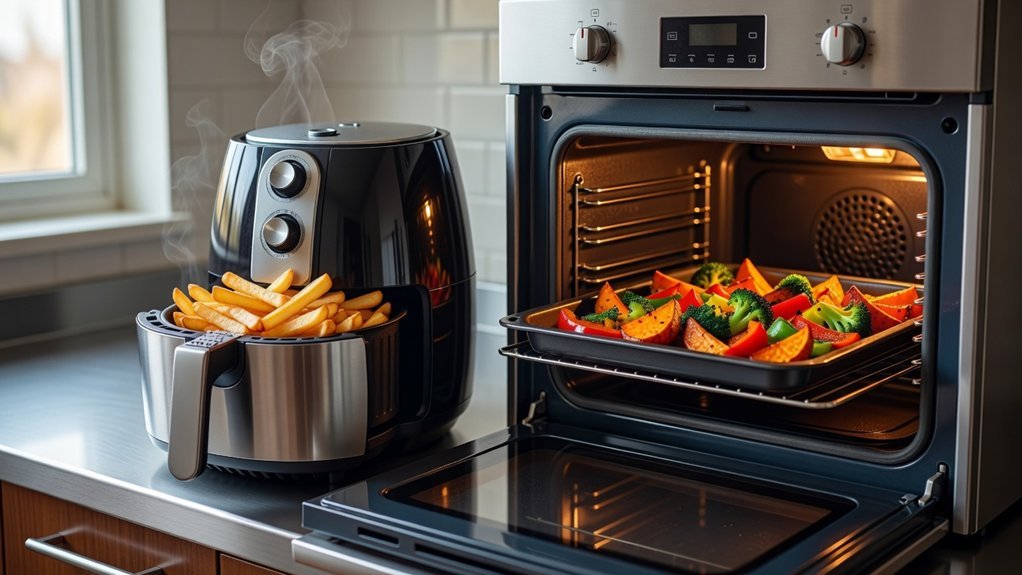
Once you factor in speed, temperature, and capacity, the differences between these two appliances become clear.
- Speed: Your air fryer’s compact chamber and powerful top element cook small batches 5–10 minutes faster than convection ovens, making it ideal for quick meals like bacon or fries.
- Temperature: Both appliances need settings 20–25°F lower than conventional ovens since circulating air cooks more efficiently. Preheating takes just 3–5 minutes for either, though your air fryer often feels ready sooner. Similar rapid preheating shows up in other kitchen appliances too, with some espresso machines featuring rapid-heating boilers that reach brewing temperature in as little as 20 seconds.
- Capacity: This is where convection ovens win. Air fryer baskets hold only 1–6 quarts, limiting you to single layers and occasional shaking. Convection ovens handle multiple racks and larger roasts without crowding, giving you far greater throughput for bigger meals.
Which Appliance Crisps and Bakes Better?
Your air fryer typically wins the crisping contest, using its smaller chamber and stronger, closer fan to force hotter air directly onto food. This shaves about 5 minutes off cook times for bacon, fries, and salmon compared to a convection oven.
When you want fried-like crispy results on wings, egg rolls, or plantains, your air fry basket delivers the best crunch with minimal oil.
Your convection oven, though, bakes more evenly across multiple racks, spreading heat gently without creating hot spots. It also retains moisture better, so salmon and dumplings won’t dry out like they might in intense air-frying conditions.
To replicate crisping through convection cooking, single-layer food on a perforated tray, flip halfway, and drop your temperature by 20–25°F.
Do You Need Both an Air Fryer and a Convection Oven?
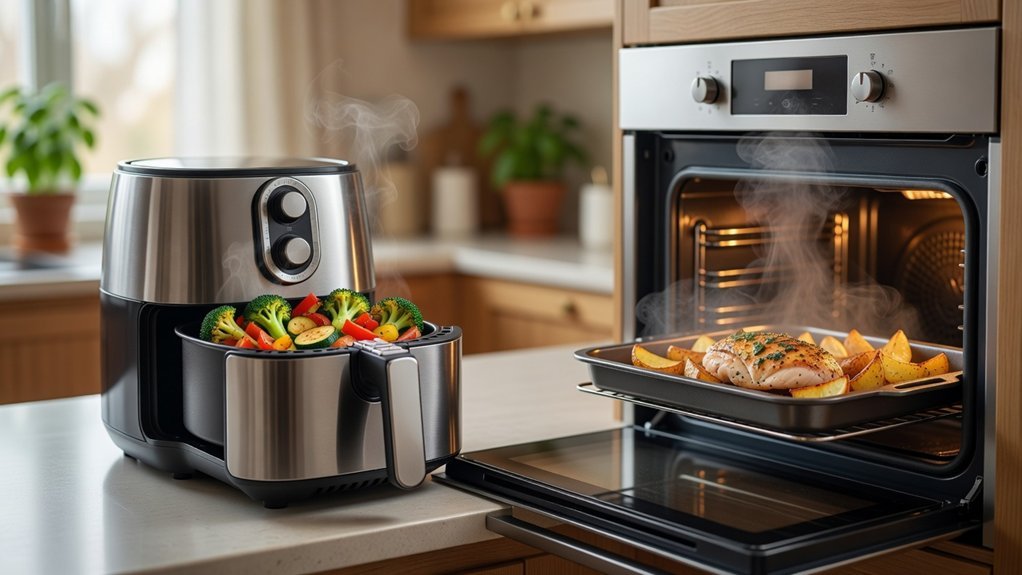
If you already own a convection oven, especially one with a dedicated Air Fry or No-Preheat Air Fry mode, you probably don’t need a separate countertop unit. Its convection fan already delivers similar crisping power at a larger capacity.
Still, an air fryer earns its counter space if your cooking habits lean toward:
- Small batches – fries, wings, or plantains cooked fast in a compact chamber.
- Quick cleanup – no need to heat or wash a full-size oven for two servings.
- Hands-off convenience – set it and walk away without preheating.
If you regularly cook for a crowd or need multiple racks, stick with your convection oven. For quick, single-serving crisping, an air fryer adds real value. Similarly, when choosing kitchen or cooling appliances, it helps to match capacity to your actual needs rather than defaulting to the largest option available.
Frequently Asked Questions
Why Are People Getting Rid of Their Air Fryers?
You’re ditching your air fryer because its small capacity forces multiple batches, non-oily foods dry out, noise and airflow trip smoke alarms, and it hogs counter space a convection oven’s “air fry” setting already covers.
Is It Worth Having Both an Air Fryer and Convection Oven?
Yes, it’s worth it if you crave crispy fried-style snacks and need bigger capacity for roasts, multi-rack baking, or multiple dishes—you’ll get quick crisping plus versatile, larger-batch cooking whenever family meals demand more space.
Is 400 in the Air Fryer the Same as 400 in the Oven?
Not exactly. Both target 400°F, but your air fryer’s concentrated airflow and compact chamber cook faster and crisp quicker. In a convection oven, you’ll often need a perforated tray and closer fan placement to match that result.
What Cannot Be Cooked in a Convection Oven?
You can’t truly deep-fry wet-battered foods like tempura, since they need oil immersion. Avoid delicate custards, soufflés, and thin batters too—they’ll collapse, toughen, or dry out under convection’s fast-moving air.